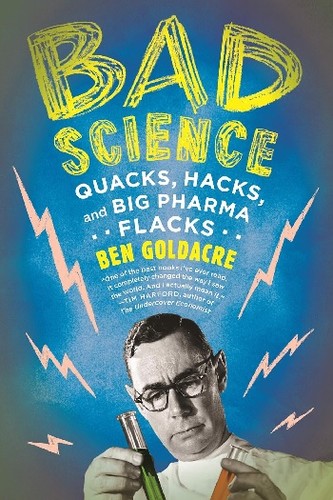
Talk to Bad Science like its author wrote you back.
Get the ideas that fit your life — not generic summaries.
- Chat with the book
- Audiobook-style main ideas
- Adapts to your life and goals
- Helps you take action
What it argues
Bad Science is Ben Goldacre's dissection of how scientific evidence gets misrepresented, distorted, and invented in the service of selling health products, generating media coverage, and protecting bad actors from accountability. Goldacre is a physician and epidemiologist, and the book reads as a practiced clinician's frustration with the gap between what the evidence actually says and what gets reported to the public.
The book covers a lot of ground quickly. Goldacre starts with the epistemically simplest case — homeopathy — and uses it to establish the basic framework: what would good evidence look like, why does anecdote fail as evidence, what does a placebo-controlled trial actually measure? From there he moves through nutritionists whose credentials don't hold up, the brain gym movement in British schools, the statistical manipulation behind cosmetics industry claims, and the catastrophic media handling of the MMR-autism controversy.
What it gets right
- 1.
Anecdote is not evidence. The reason science uses controlled trials is to separate the effect of the treatment from everything else that changed at the same time.
- 2.
The placebo effect is real and measurable, which is why it must be controlled for. Many ineffective treatments produce genuine improvement in how patients feel without affecting the underlying disease.
- 3.
Statistical literacy is a prerequisite for evaluating health claims. Relative risk reduction is nearly always more impressive than absolute risk reduction — and the latter is what matters.
What it covers
Who wrote it
Ben Goldacre is a British physician, academic, and science writer. He holds a medical degree from Oxford and a PhD in epidemiology from University College London. He ran the Bad Science column in The Guardian from 2003 to 2011 and has been a vocal critic of pharmaceutical industry practices, media science reporting, and the complementary medicine industry. He founded the AllTrials campaign, which advocates for all clinical trial results to be published, and has consulted for governments and health systems on evidence-based policy. He is also the author of Bad Pharma.
