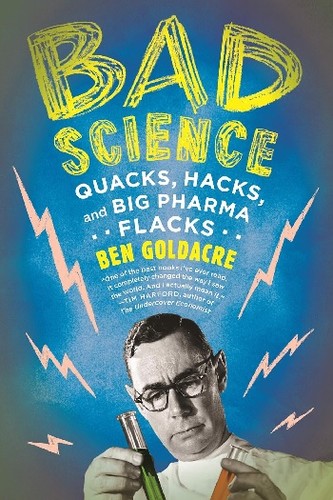
Bad Science by Ben Goldacre is a 2008 science book about scientific literacy, evidence-based medicine, media criticism. Anecdote is not evidence. The reason science uses controlled trials is to separate the effect of the treatment from everything else that changed at the same time.
Summary
Bad Science is Ben Goldacre's dissection of how scientific evidence gets misrepresented, distorted, and invented in the service of selling health products, generating media coverage, and protecting bad actors from accountability. Goldacre is a physician and epidemiologist, and the book reads as a practiced clinician's frustration with the gap between what the evidence actually says and what gets reported to the public.
The book covers a lot of ground quickly. Goldacre starts with the epistemically simplest case — homeopathy — and uses it to establish the basic framework: what would good evidence look like, why does anecdote fail as evidence, what does a placebo-controlled trial actually measure? From there he moves through nutritionists whose credentials don't hold up, the brain gym movement in British schools, the statistical manipulation behind cosmetics industry claims, and the catastrophic media handling of the MMR-autism controversy.
The MMR chapter is the book's moral center. Andrew Wakefield's fraudulent 1998 Lancet study, the media's amplification of the scare, and the measles deaths that followed are treated not as a simple story of one bad actor but as a systemic failure: of peer review, of science journalism, of the media's fundamental misunderstanding of what a study finding means. Goldacre's analysis of why the MMR story played out the way it did is among the most useful things any popular science book has done with a case study of scientific failure.
Goldacre writes with considerable wit and doesn't pretend to neutrality. He is openly contemptuous of the homeopaths, detox entrepreneurs, and nutritionists he examines, and the book has been criticized for its combative tone. But his core argument — that citizens in a democracy need the basic tools to evaluate evidence themselves rather than deferring to media coverage — is difficult to dispute. Bad Science is particularly useful as a companion to any other science book, not because it teaches you the science but because it teaches you to read the claims.
Talk to Bad Science like its author wrote you back.
Get the ideas that fit your life — not generic summaries.
- Chat with the book
- Audiobook-style main ideas
- Adapts to your life and goals
- Helps you take action
Key takeaways
- 1.
Anecdote is not evidence. The reason science uses controlled trials is to separate the effect of the treatment from everything else that changed at the same time.
- 2.
The placebo effect is real and measurable, which is why it must be controlled for. Many ineffective treatments produce genuine improvement in how patients feel without affecting the underlying disease.
- 3.
Statistical literacy is a prerequisite for evaluating health claims. Relative risk reduction is nearly always more impressive than absolute risk reduction — and the latter is what matters.
- 4.
The MMR-autism controversy was a failure of science journalism as much as of science. Journalists treated a single fraudulent study as a debate rather than evaluating the weight of accumulated evidence.
- 5.
Nutritionists with non-standard credentials and the supplement industry operate largely outside the regulatory frameworks that pharmaceutical companies must satisfy.
- 6.
Publication bias systematically distorts the medical literature: positive findings get published and negative ones don't, which makes the published record more favorable than the actual evidence.
- 7.
Media coverage of science typically fails to distinguish between preliminary findings and established evidence, treats single studies as definitive, and doesn't report on context or replication.
- 8.
Science education fails most people because it teaches facts rather than the process of evidence evaluation, leaving them vulnerable to anyone who can sound authoritative.
Discussion questions
Use these on your own, with a book club, or as chat starters in Superbook. Book club version, ready to copy or print →
- 1.
Goldacre argues that statistical literacy is a democratic necessity. What would it take to teach it effectively at a population level?
- 2.
The MMR chapter shows how a single fraudulent study caused measles deaths years later. What went wrong at each stage — from Wakefield to the Lancet to the media to parents?
- 3.
Has reading this book changed how you'll evaluate health claims in the news? What's one heuristic you'll carry forward?
- 4.
Goldacre is openly contemptuous of the people he criticizes. Does that tone help or hurt his argument?
- 5.
He draws a distinction between alternative medicine when it's used as a complement to conventional care versus when it's used instead of it. Is that a defensible line?
- 6.
The publication bias problem means the medical literature systematically overstates treatment benefits. What institutional changes would fix that, and why haven't they been made?
- 7.
How do you evaluate health claims for yourself in practice? What's your actual process, and does Goldacre's framework change it?
- 8.
Some of Goldacre's targets — nutritionists, homeopaths — provide comfort and a sense of control to patients who feel dismissed by conventional medicine. Is that value real even if the treatment isn't?
- 9.
He argues that regulatory frameworks treat pharmaceutical companies differently from supplement and alternative medicine providers. Is that differential treatment justified?
- 10.
Which case study in the book was most surprising? Did any of his targets turn out to be more defensible than you expected?
- 11.
Goldacre wrote this in 2008. Has the information environment improved or worsened since then for evaluating health claims?
- 12.
What's the most important thing you learned about how clinical trials work from reading this book?
Themes
Frequently asked questions
-
Is Bad Science worth reading?
Yes, especially if you consume health news. The book gives you a practical toolkit for evaluating claims — about clinical trials, statistics, media reporting — that transfers to almost any science story you encounter. It's readable, fast-moving, and entertaining despite being genuinely educational.
-
What is Bad Science about?
It examines how scientific evidence about health gets misrepresented in media coverage, advertising, and by practitioners of alternative medicine and pseudoscientific nutrition. Goldacre uses specific cases to teach the reader how to evaluate claims themselves.
-
Is Bad Science still accurate?
The core scientific and statistical arguments hold up. Some of the specific UK regulatory details and named practitioners have changed since 2008, but the underlying patterns Goldacre identifies — media science failures, industry manipulation, alternative medicine claims — remain relevant.
-
Who should read Bad Science?
Anyone who reads health journalism, makes decisions about supplements or alternative treatments, or wants to understand how clinical trial evidence actually works. It's also useful for journalists, medical students, and anyone involved in health communication.
-
What's the one idea from Bad Science to take away?
Ask for the absolute risk reduction, not the relative risk reduction. 'This drug reduces your risk by 50%' sounds impressive; 'this drug reduces your risk from 2% to 1%' is the same finding, but the second number tells you how much it actually matters to you.