Talk to Barbarians at the Gate like its author wrote you back.
Get the ideas that fit your life — not generic summaries.
- Chat with the book
- Audiobook-style main ideas
- Adapts to your life and goals
- Helps you take action
Barbarians at the Gate, in detail
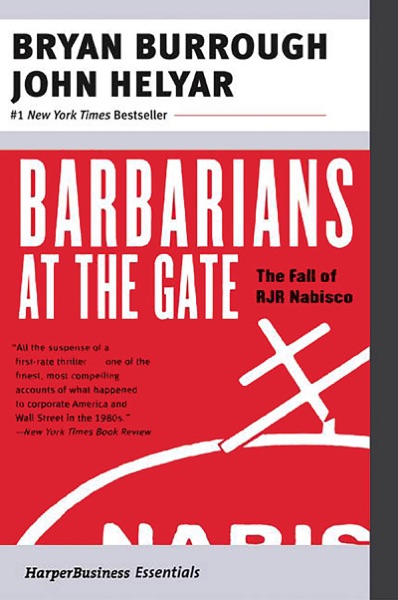
Barbarians at the Gate is Bryan Burrough and John Helyar's account of the 1988 leveraged buyout of RJR Nabisco, at the time the largest corporate transaction in history. The deal was $25 billion. The participants were some of the most powerful figures in American finance — F. Ross Johnson, the CEO who wanted to take the company private to cash out personally; Henry Kravis and George Roberts of KKR, who had pioneered the leveraged buyout as a financial instrument; and a cast of investment bankers, lawyers, and advisors whose fees ran into hundreds of millions of dollars. Burrough and Helyar reconstructed the six-week bidding war from interviews with virtually everyone involved and produced something closer to a novel than a business history.
The story works on two levels. The first is a financial thriller: competing bids, last-minute revisions, boardroom maneuvering, and phone calls at three in the morning as advisors scrambled to find another hundred million dollars somewhere. The mechanics of the LBO are explained clearly enough that readers without financial backgrounds can follow the logic of the deal, understand what leverage does to returns and risk, and see why the participants were willing to fight so ferociously over who won.
The second level is a character study. Ross Johnson is the book's most vivid figure — a genial, expansive Canadian executive who had risen through a series of corporate marriages and acquisitions and run RJR Nabisco with an imperial looseness that included an embarrassingly lavish corporate jet fleet and a culture of favoritism. His decision to put the company in play was motivated as much by self-interest as strategy, and his reading of how the board would respond proved catastrophically wrong. Henry Kravis, by contrast, is depicted as colder, more disciplined, and deeply competitive — a man who took Johnson's bid as a personal affront.
The book endures because it is a snapshot of an era: the late 1980s moment when financial engineering displaced manufacturing as the glamour industry, when the people moving capital could extract more from a business than the people running it, and when the question of who a corporation actually existed to serve was being answered very loudly in the direction of shareholders and dealmakers. Those questions have not gone away.
The big ideas
- 1.
Leveraged buyouts work by using the target company's own assets and cash flows as collateral for debt, amplifying returns (and risks) dramatically.
- 2.
Ross Johnson's miscalculation was assuming the RJR board would protect him as CEO if he brought them a buyout proposal. They were more interested in the highest price.
- 3.
KKR's Henry Kravis brought institutional discipline to a process that Johnson and his advisors treated as improvised self-enrichment. Discipline won.
