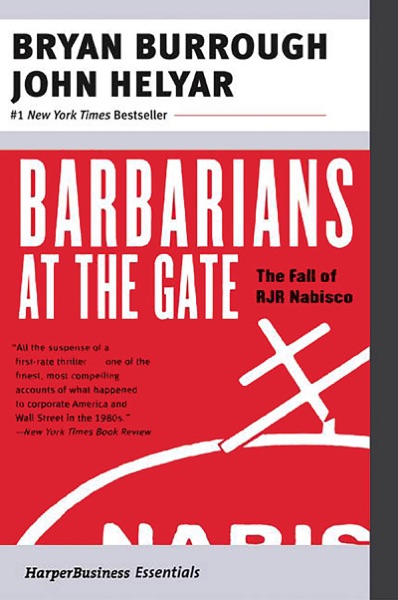
Barbarians at the Gate by Bryan Burrough is a 1989 business book about greed, leverage, corporate culture. Leveraged buyouts work by using the target company's own assets and cash flows as collateral for debt, amplifying returns (and risks) dramatically.
Summary
Barbarians at the Gate is Bryan Burrough and John Helyar's account of the 1988 leveraged buyout of RJR Nabisco, at the time the largest corporate transaction in history. The deal was $25 billion. The participants were some of the most powerful figures in American finance — F. Ross Johnson, the CEO who wanted to take the company private to cash out personally; Henry Kravis and George Roberts of KKR, who had pioneered the leveraged buyout as a financial instrument; and a cast of investment bankers, lawyers, and advisors whose fees ran into hundreds of millions of dollars. Burrough and Helyar reconstructed the six-week bidding war from interviews with virtually everyone involved and produced something closer to a novel than a business history.
The story works on two levels. The first is a financial thriller: competing bids, last-minute revisions, boardroom maneuvering, and phone calls at three in the morning as advisors scrambled to find another hundred million dollars somewhere. The mechanics of the LBO are explained clearly enough that readers without financial backgrounds can follow the logic of the deal, understand what leverage does to returns and risk, and see why the participants were willing to fight so ferociously over who won.
The second level is a character study. Ross Johnson is the book's most vivid figure — a genial, expansive Canadian executive who had risen through a series of corporate marriages and acquisitions and run RJR Nabisco with an imperial looseness that included an embarrassingly lavish corporate jet fleet and a culture of favoritism. His decision to put the company in play was motivated as much by self-interest as strategy, and his reading of how the board would respond proved catastrophically wrong. Henry Kravis, by contrast, is depicted as colder, more disciplined, and deeply competitive — a man who took Johnson's bid as a personal affront.
The book endures because it is a snapshot of an era: the late 1980s moment when financial engineering displaced manufacturing as the glamour industry, when the people moving capital could extract more from a business than the people running it, and when the question of who a corporation actually existed to serve was being answered very loudly in the direction of shareholders and dealmakers. Those questions have not gone away.
Talk to Barbarians at the Gate like its author wrote you back.
Get the ideas that fit your life — not generic summaries.
- Chat with the book
- Audiobook-style main ideas
- Adapts to your life and goals
- Helps you take action
Key takeaways
- 1.
Leveraged buyouts work by using the target company's own assets and cash flows as collateral for debt, amplifying returns (and risks) dramatically.
- 2.
Ross Johnson's miscalculation was assuming the RJR board would protect him as CEO if he brought them a buyout proposal. They were more interested in the highest price.
- 3.
KKR's Henry Kravis brought institutional discipline to a process that Johnson and his advisors treated as improvised self-enrichment. Discipline won.
- 4.
The fees involved — hundreds of millions to investment banks and law firms — represented a transfer of wealth from shareholders and employees to financial intermediaries that had no precedent in scale.
- 5.
Corporate culture at RJR under Johnson was a study in perks run amok: a fleet of corporate jets, inflated executive compensation, and an atmosphere where loyalty to the CEO mattered more than performance.
- 6.
The LBO boom of the 1980s was partly made possible by junk bond financing pioneered by Michael Milken, who could raise capital for deals that traditional banks wouldn't touch.
- 7.
The public narrative framing buyout firms as efficiency-maximizers obscured a simpler truth: these deals transferred wealth from one set of people to another, and the workers were rarely among the winners.
- 8.
The media's role in the bidding war was significant — leaks, rumors, and press coverage influenced the auction process and the perceptions of the key participants.
Discussion questions
Use these on your own, with a book club, or as chat starters in Superbook. Book club version, ready to copy or print →
- 1.
Ross Johnson believed the board would protect his position if he brought them a deal. Where in your own experience have you seen someone misread an institution's loyalty to them?
- 2.
The book describes an era when financial engineering displaced manufacturing as the prestige industry. What are the downstream consequences of that shift, and do you see a reversal happening?
- 3.
The fees generated by the RJR deal were staggering. At what point does financial intermediation become extraction rather than value creation?
- 4.
Johnson's management style relied on personal relationships, lavish perks, and loyalty. Kravis ran KKR with metrics and discipline. Which model is more durable, and at what cost?
- 5.
The LBO as a financial structure transfers risk from equity holders to debt holders and, ultimately, to employees if the debt can't be serviced. Who should bear that risk?
- 6.
Burrough and Helyar describe the advisory firms competing for roles in the deal despite obvious conflicts of interest. What does that tell you about how financial markets actually function?
- 7.
The book was written in 1989. Which dynamics it describes have changed since then, and which ones have simply scaled up?
- 8.
Johnson is a complex character — charismatic, generous to his inner circle, and ultimately willing to harm employees and shareholders for his own benefit. How do you think about people who fit that profile?
- 9.
KKR's thesis was that public company management teams were systematically under-performing and that private ownership would create accountability. Was the thesis right in this case?
- 10.
The deal made hundreds of people very rich and left RJR Nabisco with crushing debt. What would it take to construct a deal structure where that outcome didn't happen?
- 11.
The media coverage of the bidding war affected the process. How does public exposure change behavior in high-stakes negotiations?
- 12.
What does the RJR story say about what boards of directors are actually for?
Themes
Frequently asked questions
-
Do I need to understand finance to enjoy Barbarians at the Gate?
No. The book explains the mechanics as it goes, and the authors were writing for general readers. The financial concepts are context for the human drama, which is what drives the narrative. Most readers find the character study more gripping than the numbers.
-
Is Barbarians at the Gate still relevant in 2026?
Yes. Private equity buyouts remain a dominant force in corporate finance, and the questions the book raises — about who corporations serve, how management incentives distort decision-making, and what leverage does to organizations — are as live now as they were in 1988.
-
How long is Barbarians at the Gate?
Around 500 pages, roughly twelve to thirteen hours of reading. Some readers find the middle section (the bidding process) dense; the opening and closing sections are more narrative and move faster.
-
Who is the book's villain, if it has one?
The authors are careful not to assign clear villainy. Johnson is the most sympathetic-then-damning portrait: his failures are of ambition and self-delusion rather than pure malice. Kravis is colder but arguably the more honest about what he was doing.
-
What is the best single takeaway from the book?
That the people running large institutions often understand their own interests very clearly and the institution's interests much less so, and that the gap between those two things is where most of the damage happens.
Similar books
Liar's Poker
Michael Lewis
The Big Short: Inside the Doomsday Machine
Michael Lewis
Bad Blood: Secrets and Lies in a Silicon Valley Startup
John Carreyrou
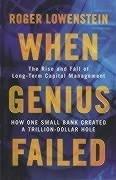
When Genius Failed
Roger Lowenstein
