Talk to Behind the Cloud like its author wrote you back.
Get the ideas that fit your life — not generic summaries.
- Chat with the book
- Audiobook-style main ideas
- Adapts to your life and goals
- Helps you take action
Behind the Cloud, in detail
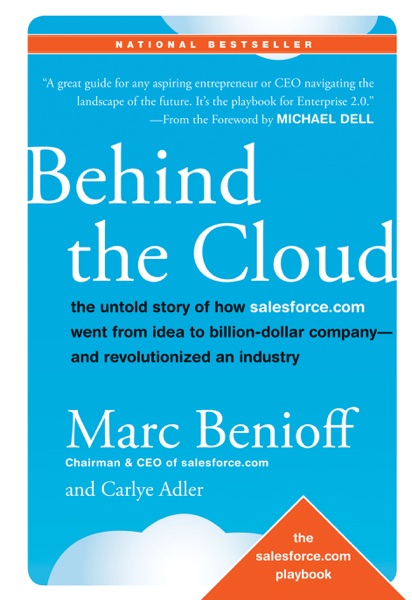
Behind the Cloud is Marc Benioff's account of building Salesforce from a startup in his apartment to the first cloud computing company to reach $1 billion in revenue. Published in 2009, a decade after Salesforce's founding, it's organized as a series of short tactical chapters grouped by theme: sales, marketing, technology, philanthropy, culture. The structure reflects Benioff's personality — relentlessly practical, fond of frameworks, impatient with pure theory.
The book's most interesting contribution is its account of how Benioff built a market that didn't exist yet. When Salesforce launched in 1999, enterprise software meant expensive, slow, on-premise installations. The idea of renting software over the internet seemed absurd to most enterprise buyers. Benioff's marketing strategy was explicitly adversarial: the "End of Software" campaign, the mock protests at rival conferences, the relentless repetition of a simple message. He didn't just build a better product; he redefined the category.
The 1/1/1 model — donating 1% of equity, 1% of product, and 1% of employee time to charitable causes from the company's founding — gets significant attention. Benioff argues that integrated philanthropy was both ethically right and strategically useful: it differentiated the company's culture, attracted and retained employees, and created a reputation that outlasted any single marketing campaign. The model has since been adopted by hundreds of technology companies.
The book reads as a manifesto as much as a memoir. Benioff is not a neutral narrator of his own story, and the tone can veer toward the promotional. Some episodes are presented as more prescient than they probably felt in real time. But for readers interested in how SaaS businesses were pioneered, how to build a company culture from scratch, or how to market a genuinely disruptive product against entrenched incumbents, the tactical specificity makes it more useful than most business memoirs.
The big ideas
- 1.
Salesforce's early growth was driven by a deliberately disruptive marketing strategy — the 'End of Software' campaign — that attacked the incumbents' category rather than competing within it.
- 2.
The SaaS model's initial resistance from enterprise buyers required extensive trust-building: Salesforce invested heavily in security, uptime transparency, and customer references before the model became accepted.
- 3.
Benioff's 'V2MOM' framework — Vision, Values, Methods, Obstacles, Measures — became Salesforce's primary management alignment tool, used at every level of the organization from day one.
