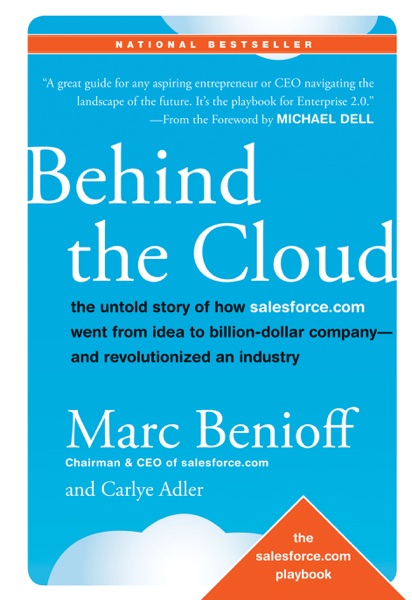
Behind the Cloud by Marc Benioff is a 2009 business book about entrepreneurship, saas, sales. Salesforce's early growth was driven by a deliberately disruptive marketing strategy — the 'End of Software' campaign — that attacked the incumbents' category rather than competing within it.
Summary
Behind the Cloud is Marc Benioff's account of building Salesforce from a startup in his apartment to the first cloud computing company to reach $1 billion in revenue. Published in 2009, a decade after Salesforce's founding, it's organized as a series of short tactical chapters grouped by theme: sales, marketing, technology, philanthropy, culture. The structure reflects Benioff's personality — relentlessly practical, fond of frameworks, impatient with pure theory.
The book's most interesting contribution is its account of how Benioff built a market that didn't exist yet. When Salesforce launched in 1999, enterprise software meant expensive, slow, on-premise installations. The idea of renting software over the internet seemed absurd to most enterprise buyers. Benioff's marketing strategy was explicitly adversarial: the "End of Software" campaign, the mock protests at rival conferences, the relentless repetition of a simple message. He didn't just build a better product; he redefined the category.
The 1/1/1 model — donating 1% of equity, 1% of product, and 1% of employee time to charitable causes from the company's founding — gets significant attention. Benioff argues that integrated philanthropy was both ethically right and strategically useful: it differentiated the company's culture, attracted and retained employees, and created a reputation that outlasted any single marketing campaign. The model has since been adopted by hundreds of technology companies.
The book reads as a manifesto as much as a memoir. Benioff is not a neutral narrator of his own story, and the tone can veer toward the promotional. Some episodes are presented as more prescient than they probably felt in real time. But for readers interested in how SaaS businesses were pioneered, how to build a company culture from scratch, or how to market a genuinely disruptive product against entrenched incumbents, the tactical specificity makes it more useful than most business memoirs.
Talk to Behind the Cloud like its author wrote you back.
Get the ideas that fit your life — not generic summaries.
- Chat with the book
- Audiobook-style main ideas
- Adapts to your life and goals
- Helps you take action
Key takeaways
- 1.
Salesforce's early growth was driven by a deliberately disruptive marketing strategy — the 'End of Software' campaign — that attacked the incumbents' category rather than competing within it.
- 2.
The SaaS model's initial resistance from enterprise buyers required extensive trust-building: Salesforce invested heavily in security, uptime transparency, and customer references before the model became accepted.
- 3.
Benioff's 'V2MOM' framework — Vision, Values, Methods, Obstacles, Measures — became Salesforce's primary management alignment tool, used at every level of the organization from day one.
- 4.
The 1/1/1 philanthropy model (equity, product, employee time) was built into the company at founding, when it cost little, rather than bolted on after success, when it would have been much harder to implement.
- 5.
Enterprise sales at scale requires building a system: training, playbooks, compensation structures, and management layers that don't depend on any individual's talent or relationships.
- 6.
Marketing a new software category requires creating enemies as much as allies. Benioff's willingness to name and attack competitors (including staging fake protests at Oracle events) kept Salesforce in front of buyers' minds.
- 7.
The AppExchange partner ecosystem was a deliberate platform strategy that extended Salesforce's value through third-party applications, creating switching costs and network effects.
- 8.
Culture in a fast-growing company requires constant active maintenance. Benioff's attention to values, rituals, and recognition kept the culture coherent through rapid scaling.
Discussion questions
Use these on your own, with a book club, or as chat starters in Superbook. Book club version, ready to copy or print →
- 1.
Benioff argues that integrated philanthropy (the 1/1/1 model) was both right and strategically smart. Can those two justifications coexist, or does the strategic framing undermine the ethical one?
- 2.
The 'End of Software' campaign was deliberately adversarial. When is attacking an incumbent's category more effective than competing within it?
- 3.
Benioff is not a neutral narrator of his own story. Where do you notice the memoir's framing shaping how events are presented, and how do you read for that?
- 4.
The V2MOM framework requires alignment from the CEO down. What makes that kind of alignment tool work in some organizations and fail in others?
- 5.
Salesforce grew by building a system around enterprise sales rather than depending on individual salespeople. What does that imply about what sales talent is actually for in a scaled organization?
- 6.
The book was written in 2009. How much of what Benioff describes as Salesforce's competitive advantages still hold, and how has the market shifted?
- 7.
Benioff staged mock protests at competitor conferences. Is that kind of aggressive competitive marketing admirable, problematic, or somewhere in between?
- 8.
The AppExchange was a platform strategy that created network effects. What determined whether partners invested in building on Salesforce rather than building independent products?
- 9.
Benioff describes Salesforce's early days as a period of enormous uncertainty. What decisions during that period look like obvious choices in retrospect but were genuinely risky at the time?
- 10.
The book argues that building culture from day one is easier than fixing it later. What does that imply for early-stage companies about the tradeoffs between culture investment and other priorities?
- 11.
How does Benioff's approach to building Salesforce compare to other startup stories you've read or heard? What's distinctive, and what follows a familiar pattern?
Themes
Frequently asked questions
-
Is Behind the Cloud still relevant for founders today?
Partly. The tactical advice on enterprise sales, category marketing, and culture is still applicable. The SaaS model is now standard rather than radical, so the sections on convincing skeptical buyers have more historical than practical value. The philanthropy framework and the organizational alignment tools remain useful.
-
How long does it take to read Behind the Cloud?
Around four to five hours. The chapter structure — short, thematic, tactical — makes it easy to read in installments. Many readers skim chapters that don't apply to their situation, which is a legitimate use of the book.
-
Is this book primarily about Salesforce's history or about startup strategy?
Both, but the balance tips toward strategy. Benioff explicitly frames each section as a lesson, not just a story. Readers who want deep Salesforce history will need to supplement; readers who want startup playbook thinking will find it directly useful.
-
How does Behind the Cloud compare to Shoe Dog or other founder memoirs?
It's more tactical and less narrative than Shoe Dog. Benioff is interested in giving you frameworks you can apply; Knight is more interested in telling a story. Both are honest about difficulty, but in different ways — Benioff's version is more prescriptive, Knight's more atmospheric.
-
Who should read this book?
Founders or executives at B2B software companies, sales leaders building enterprise teams, and anyone interested in category-creation marketing. It's less useful for consumer-focused businesses or companies in markets where the SaaS model is already mature.
Similar books
Shoe Dog: A Memoir by the Creator of Nike
Phil Knight
The Hard Thing About Hard Things
Ben Horowitz
No Rules Rules: Netflix and the Culture of Reinvention
Reed Hastings and Erin Meyer
The Lean Startup
Eric Ries
