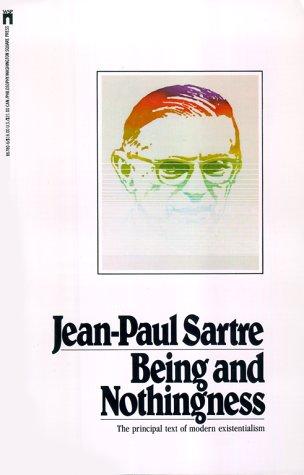
Talk to Being and Nothingness like its author wrote you back.
Get the ideas that fit your life — not generic summaries.
- Chat with the book
- Audiobook-style main ideas
- Adapts to your life and goals
- Helps you take action
What it argues
Being and Nothingness is Sartre's major philosophical treatise and the founding text of French existentialism. Written during the Nazi occupation of Paris and published in 1943, it attempts to describe the structure of consciousness and human freedom without appeal to God, essence, or fixed human nature. The project is phenomenological — following Husserl and Heidegger in starting from conscious experience — but arrives at conclusions that are distinctly Sartrean and often discomforting.
The central distinction is between being-in-itself (être-en-soi) and being-for-itself (être-pour-soi). Things — rocks, tables, dead matter — are in-itself: dense, opaque, what they are. Consciousness is for-itself: it is precisely not a thing but a nothingness, a hole in being, a perpetual negation of what it is. Consciousness is always ahead of itself, always projecting into possibilities rather than settled in a fixed nature. This is why radical freedom is not a discovery but an inescapable condition: we are "condemned to be free."
What it gets right
- 1.
Human consciousness is not a thing but a nothingness — it is always negating what it currently is in order to project toward possibilities.
- 2.
We are condemned to be free: freedom is not a gift but the inescapable structure of consciousness, which cannot settle into a fixed nature.
- 3.
Bad faith is the attempt to deny freedom by treating oneself as a thing determined by circumstances, roles, or nature rather than ongoing choice.
What it covers
Who wrote it
Jean-Paul Sartre (1905–1980) was a French philosopher, novelist, and playwright who became the central figure of existentialism in the mid-20th century. His major philosophical works include Being and Nothingness (1943) and Critique of Dialectical Reason (1960). His novels, plays, and essays — including Nausea, No Exit, and The Roads to Freedom trilogy — extended his philosophy into literary form. He declined the Nobel Prize in Literature in 1964. His lifelong relationship with Simone de Beauvoir and his political commitments to Marxism shaped both his work and his public presence.
