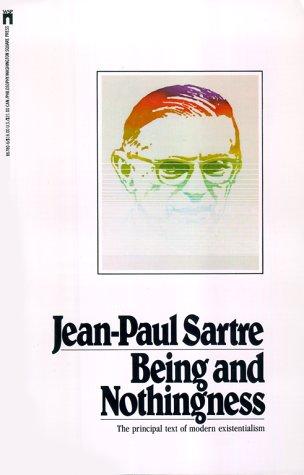
Being and Nothingness by Jean-Paul Sartre is a 1943 philosophy book about freedom, consciousness, bad faith. Human consciousness is not a thing but a nothingness — it is always negating what it currently is in order to project toward possibilities.
Summary
Being and Nothingness is Sartre's major philosophical treatise and the founding text of French existentialism. Written during the Nazi occupation of Paris and published in 1943, it attempts to describe the structure of consciousness and human freedom without appeal to God, essence, or fixed human nature. The project is phenomenological — following Husserl and Heidegger in starting from conscious experience — but arrives at conclusions that are distinctly Sartrean and often discomforting.
The central distinction is between being-in-itself (être-en-soi) and being-for-itself (être-pour-soi). Things — rocks, tables, dead matter — are in-itself: dense, opaque, what they are. Consciousness is for-itself: it is precisely not a thing but a nothingness, a hole in being, a perpetual negation of what it is. Consciousness is always ahead of itself, always projecting into possibilities rather than settled in a fixed nature. This is why radical freedom is not a discovery but an inescapable condition: we are "condemned to be free."
Bad faith (mauvaise foi) is the concept that drives the book's ethical implications. It is the attempt to flee from freedom by treating oneself as a thing — by claiming one has no choice, is determined by circumstance, is simply playing a role. The waiter who "plays at being a waiter," the woman who pretends not to notice her companion's advances: both are in bad faith, denying the consciousness they are in favor of a fixed identity they can inhabit without anxiety. Sartre does not claim bad faith can be permanently overcome but argues that authentic existence requires acknowledging one's freedom, even when that acknowledgment is terrifying.
The book's sections on the look, on being-for-others, and on the body are among the most celebrated: when I am looked at, I experience myself as an object in another's world, which generates shame and the attempt to recapture my freedom by looking back. Relationships are analyzed as fundamentally conflictual — love, masochism, sadism — as each consciousness attempts to be recognized as a free subject while inevitably objectifying the other. It is a bleak anthropology, and Sartre knew it. The promised concluding volume on ethics was never written.
Talk to Being and Nothingness like its author wrote you back.
Get the ideas that fit your life — not generic summaries.
- Chat with the book
- Audiobook-style main ideas
- Adapts to your life and goals
- Helps you take action
Key takeaways
- 1.
Human consciousness is not a thing but a nothingness — it is always negating what it currently is in order to project toward possibilities.
- 2.
We are condemned to be free: freedom is not a gift but the inescapable structure of consciousness, which cannot settle into a fixed nature.
- 3.
Bad faith is the attempt to deny freedom by treating oneself as a thing determined by circumstances, roles, or nature rather than ongoing choice.
- 4.
Existence precedes essence: there is no pre-given human nature that determines what we must be; we create ourselves through our choices.
- 5.
The look of another person objectifies me — I experience myself as an object in their world — generating shame and the attempt to recapture subjectivity.
- 6.
Authentic existence means acknowledging radical freedom and the responsibility that comes with it, even when that acknowledgment produces anguish.
- 7.
Love is not the peaceful union of two freedoms but a fundamentally unstable project of wanting to be the world for another while remaining free oneself.
- 8.
The for-itself is a perpetual lack — it is always not-yet what it is trying to be, which is both the source of human suffering and the condition of possibility.
Discussion questions
Use these on your own, with a book club, or as chat starters in Superbook. Book club version, ready to copy or print →
- 1.
Sartre says we are condemned to be free — that not choosing is itself a choice. Can you identify a situation in your own life where you claimed you had no choice but actually were choosing?
- 2.
Bad faith takes the form of claiming determination where there is freedom. What forms of bad faith are most socially accepted or invisible in your own culture?
- 3.
The waiter playing at being a waiter is Sartre's classic example of bad faith. Do you think professional roles necessarily involve bad faith, or is there an authentic way to inhabit a role?
- 4.
Sartre argues that all relationships involve an irreducible conflict between freedoms. Does your experience of close relationships bear that out, or does it describe only a subset of relationships?
- 5.
Authentic existence involves acknowledging anxiety — the nausea of confronting your freedom without any external support. Is that kind of authenticity sustainable over a lifetime?
- 6.
Sartre says there is no human nature given in advance. What do you think is most stable and defining about yourself — is it chosen or given?
- 7.
The look of the other is described as fundamentally threatening, converting me into an object. Is that true of all being-seen, or only under certain conditions?
- 8.
Being and Nothingness was written during the Nazi occupation of Paris. Does the historical context change how you read its emphasis on radical freedom and responsibility?
- 9.
The promised ethics was never written. Do you think the framework of Being and Nothingness can support an ethics, or does the radical individualism of its freedom undercut the possibility?
- 10.
Sartre distinguishes shame (awareness of being seen as an object) from guilt (awareness of having done something wrong). Are those really different experiences for you?
- 11.
What would it mean to live authentically according to Sartre? Can you describe what that would look like concretely in a day or a relationship?
- 12.
Sartre denies the unconscious. All consciousness is self-aware at some level. Does that seem true to you, and what does it imply for psychotherapy or self-understanding?
Themes
Frequently asked questions
-
What is the main argument of Being and Nothingness?
That consciousness is a nothingness — not a thing but a perpetual negation — and that this structure makes radical freedom inescapable. There is no fixed human nature, so we are responsible for what we make of ourselves. Bad faith is the attempt to flee that responsibility by pretending we are determined.
-
What is bad faith in Sartre's sense?
The attempt to deny freedom by treating yourself as a thing — playing a social role as if it were fixed, claiming circumstances left you no choice, or surrendering your judgment to external authority. Bad faith is self-deception about the nature of consciousness.
-
Is Being and Nothingness too long to read?
It is very long and demanding. Many readers engage with it through secondary literature (Hazel Barnes' translation introduction, or Jonathan Webber's guide) or through Sartre's shorter lecture Existentialism Is a Humanism, which covers the key ideas accessibly.
-
How does Sartre's existentialism differ from Heidegger's?
Sartre adapts Heidegger's framework but rejects his later turn toward 'being' and mysticism. Sartre's framework is more focused on individual freedom, consciousness, and interpersonal conflict. Heidegger criticized Sartre for remaining too humanist and not thinking being itself deeply enough.
-
What does 'existence precedes essence' mean?
For artifacts, essence comes first: a knife is designed before it is made. Sartre argues that for humans there is no prior design — we exist first, then create our own essence through choices. This inverts the traditional theological view that humans were created with a fixed nature or purpose.