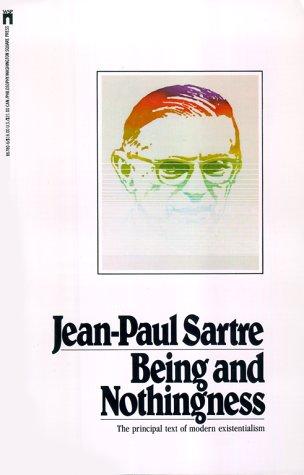
Talk to Being and Nothingness like its author wrote you back.
Get the ideas that fit your life — not generic summaries.
- Chat with the book
- Audiobook-style main ideas
- Adapts to your life and goals
- Helps you take action
Being and Nothingness, in detail
Being and Nothingness is Sartre's major philosophical treatise and the founding text of French existentialism. Written during the Nazi occupation of Paris and published in 1943, it attempts to describe the structure of consciousness and human freedom without appeal to God, essence, or fixed human nature. The project is phenomenological — following Husserl and Heidegger in starting from conscious experience — but arrives at conclusions that are distinctly Sartrean and often discomforting.
The central distinction is between being-in-itself (être-en-soi) and being-for-itself (être-pour-soi). Things — rocks, tables, dead matter — are in-itself: dense, opaque, what they are. Consciousness is for-itself: it is precisely not a thing but a nothingness, a hole in being, a perpetual negation of what it is. Consciousness is always ahead of itself, always projecting into possibilities rather than settled in a fixed nature. This is why radical freedom is not a discovery but an inescapable condition: we are "condemned to be free."
Bad faith (mauvaise foi) is the concept that drives the book's ethical implications. It is the attempt to flee from freedom by treating oneself as a thing — by claiming one has no choice, is determined by circumstance, is simply playing a role. The waiter who "plays at being a waiter," the woman who pretends not to notice her companion's advances: both are in bad faith, denying the consciousness they are in favor of a fixed identity they can inhabit without anxiety. Sartre does not claim bad faith can be permanently overcome but argues that authentic existence requires acknowledging one's freedom, even when that acknowledgment is terrifying.
The book's sections on the look, on being-for-others, and on the body are among the most celebrated: when I am looked at, I experience myself as an object in another's world, which generates shame and the attempt to recapture my freedom by looking back. Relationships are analyzed as fundamentally conflictual — love, masochism, sadism — as each consciousness attempts to be recognized as a free subject while inevitably objectifying the other. It is a bleak anthropology, and Sartre knew it. The promised concluding volume on ethics was never written.
The big ideas
- 1.
Human consciousness is not a thing but a nothingness — it is always negating what it currently is in order to project toward possibilities.
- 2.
We are condemned to be free: freedom is not a gift but the inescapable structure of consciousness, which cannot settle into a fixed nature.
- 3.
Bad faith is the attempt to deny freedom by treating oneself as a thing determined by circumstances, roles, or nature rather than ongoing choice.
