Talk to Bel Canto like its author wrote you back.
Get the ideas that fit your life — not generic summaries.
- Chat with the book
- Audiobook-style main ideas
- Adapts to your life and goals
- Helps you take action
What it argues
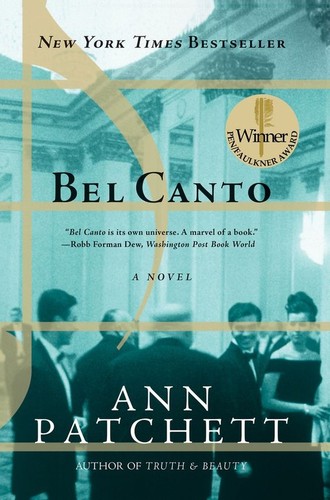
Bel Canto opens at a birthday party in an unnamed South American country: a Japanese industrialist, Hosokawa, is celebrating in the private residence of the country's vice president, the sole attraction being a performance by his favorite soprano, Roxane Coss. When terrorists seize the building and take the guests hostage, what begins as a crisis gradually transforms into something stranger — a months-long suspension of ordinary life inside a locked compound. This is Patchett's great subject: what happens to people when normal time stops.
The novel is interested in the way extreme circumstances strip away social roles and reveal what people actually are. Hosokawa, who speaks no Spanish, falls quietly and completely in love with Roxane. A young general's aide named Gen becomes a translator for everyone and eventually falls for one of the terrorists — a girl named Carmen who has taught herself to read in the jungle. The terrorists themselves begin to lose their revolutionary certainty. The opera that Roxane sings every day becomes the organizing principle of the hostages' lives, a kind of grace that nobody earned and nobody quite understands.
What it gets right
- 1.
The hostage crisis becomes a protected space where people who would never meet fall into genuine love — the novel asks whether that love is real even if it can only exist in suspension.
- 2.
Music in Bel Canto functions as a universal language that dissolves hierarchy, nationality, and enmity in ways that spoken language cannot.
- 3.
Patchett is interested in the way routine creates identity: during the siege, as new routines emerge, everyone becomes slightly different from who they were.
What it covers
Who wrote it
Ann Patchett is an American novelist and co-owner of Parnassus Books in Nashville, Tennessee. Her novels include The Patron Saint of Liars, Taft, The Magician's Assistant, Run, Commonwealth, and The Dutch House. Bel Canto (2001) won both the PEN/Faulkner Award and the Orange Prize for Fiction. She is known for precise, patient prose and a recurring interest in how strangers become family. Her nonfiction collection This Is the Story of a Happy Marriage is widely read alongside her novels.
