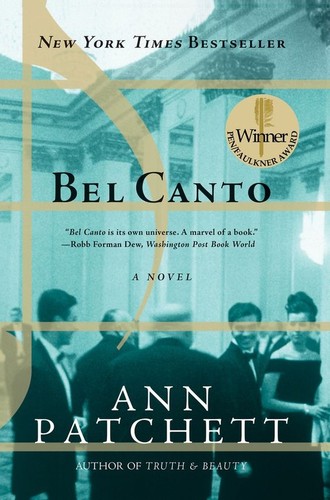
Bel Canto by Ann Patchett is a 2001 literary fiction book about music and transcendence, love across barriers, time and suspension. The hostage crisis becomes a protected space where people who would never meet fall into genuine love — the novel asks whether that love is real even if it can only exist in suspension.
Summary
Bel Canto opens at a birthday party in an unnamed South American country: a Japanese industrialist, Hosokawa, is celebrating in the private residence of the country's vice president, the sole attraction being a performance by his favorite soprano, Roxane Coss. When terrorists seize the building and take the guests hostage, what begins as a crisis gradually transforms into something stranger — a months-long suspension of ordinary life inside a locked compound. This is Patchett's great subject: what happens to people when normal time stops.
The novel is interested in the way extreme circumstances strip away social roles and reveal what people actually are. Hosokawa, who speaks no Spanish, falls quietly and completely in love with Roxane. A young general's aide named Gen becomes a translator for everyone and eventually falls for one of the terrorists — a girl named Carmen who has taught herself to read in the jungle. The terrorists themselves begin to lose their revolutionary certainty. The opera that Roxane sings every day becomes the organizing principle of the hostages' lives, a kind of grace that nobody earned and nobody quite understands.
Patchett's prose is precise and unhurried — she treats violence and beauty with the same level gaze. The novel never lets you forget that this cannot last, that the outside world is waiting to reassert itself. But she earns the sadness of that ending through the depth of what she builds. The Stockholm syndrome element is present but Patchett resists making it merely psychological; she's more interested in love as a fact than love as a pathology.
This is a novel that some readers find too slow, too interior, too much a meditation and not enough a story. Those who stay with it tend to love it deeply. It won the PEN/Faulkner Award and the Orange Prize in 2002. Compared to Patchett's other work, it's her most lyrical and most heartbreaking — a book about the briefest possible paradise.
Talk to Bel Canto like its author wrote you back.
Get the ideas that fit your life — not generic summaries.
- Chat with the book
- Audiobook-style main ideas
- Adapts to your life and goals
- Helps you take action
Key takeaways
- 1.
The hostage crisis becomes a protected space where people who would never meet fall into genuine love — the novel asks whether that love is real even if it can only exist in suspension.
- 2.
Music in Bel Canto functions as a universal language that dissolves hierarchy, nationality, and enmity in ways that spoken language cannot.
- 3.
Patchett is interested in the way routine creates identity: during the siege, as new routines emerge, everyone becomes slightly different from who they were.
- 4.
The relationship between Hosokawa and Roxane is built almost entirely through proximity and music rather than conversation — a study in what love requires and what it doesn't.
- 5.
Gen's role as translator gives him enormous power; his love for Carmen develops partly because she approaches him as a full human being rather than a function.
- 6.
The terrorists are rendered with sympathy and specificity — Patchett refuses the dehumanization that would make the novel's violence easier to swallow.
- 7.
Time inside the compound becomes different in texture from time outside: the novel captures how humans adapt to any circumstances and begin to call them home.
- 8.
The ending is not a surprise thematically, but it is devastating emotionally — a reminder that Patchett never let you forget the siege had to end.
Discussion questions
Use these on your own, with a book club, or as chat starters in Superbook. Book club version, ready to copy or print →
- 1.
The hostages and terrorists gradually begin to live as a community. At what point did that feel plausible to you, and at what point did it strain credibility?
- 2.
Roxane's singing is the novel's organizing grace. Can music actually do what Patchett claims it does here — dissolve barriers and create genuine connection between enemies?
- 3.
Hosokawa's love for Roxane is present before they speak a word in a shared language. What does Patchett think love is, based on this novel?
- 4.
Gen falls in love with Carmen, who is technically his captor. The novel doesn't treat this as pathology. Do you read it the same way?
- 5.
The epilogue has divided readers sharply. What did you make of it — does it honor what came before or undercut it?
- 6.
Patchett renders the guerrillas as individuals with specific histories and desires. How did that affect your response to the ending?
- 7.
The vice president's residence becomes a kind of paradise — a word Patchett uses deliberately. What makes a paradise, and why does this one feel earned?
- 8.
Several characters discover abilities they didn't know they had during the siege — cooking, chess, singing. What does that say about ordinary life?
- 9.
Compare the love story in Bel Canto to a love story you know from a novel with more conventional circumstances. Does extreme setting make love feel more or less real?
- 10.
The outside world barely intrudes during the siege. How does Patchett use that narrative choice, and what does it cost the novel?
- 11.
The novel was inspired partly by the 1996 Japanese embassy hostage crisis in Lima. Does knowing that change how you read it?
- 12.
Who in the novel changes the most over the course of the siege? Is change the same as growth here?
Themes
Frequently asked questions
-
Is Bel Canto worth reading?
Yes, especially if you have patience for a slow-building, interior novel. It's one of the more quietly devastating books in contemporary American fiction. If you need constant plot momentum it will frustrate you. If you can settle into its suspended-time atmosphere, it rewards fully.
-
What is Bel Canto about, without spoilers?
A group of diplomats, businesspeople, and staff are taken hostage at a party in South America. Over the months-long standoff, they and their captors form an unlikely community centered on the daily singing of a famous opera soprano. It's about what love, beauty, and routine mean when stripped of ordinary context.
-
Is Bel Canto based on a real event?
It was inspired by the 1996-97 Japanese embassy hostage crisis in Lima, Peru, where the MRTA held 72 hostages for four months before Peruvian forces stormed the building. Patchett changed almost everything — setting, characters, outcome — but the basic situation echoes that event.
-
Who shouldn't read Bel Canto?
Readers expecting a thriller or a tense political novel will be disappointed. The pacing is meditative, the violence mostly off-screen, and the central concerns are musical and romantic rather than political. The epilogue also divides readers — if you hate endings that feel like they undercut what came before, be warned.
-
Is there a film adaptation?
Yes. A film adaptation was released in 2018, directed by Paul Weitz and starring Julianne Moore as Roxane Coss. Most readers felt it captured the atmosphere imperfectly and the emotional core barely at all.