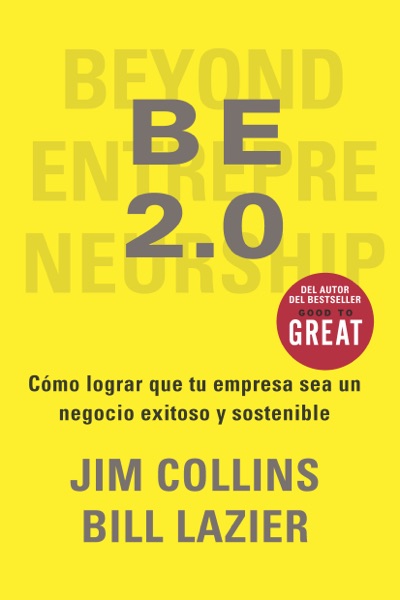
Talk to Beyond Entrepreneurship like its author wrote you back.
Get the ideas that fit your life — not generic summaries.
- Chat with the book
- Audiobook-style main ideas
- Adapts to your life and goals
- Helps you take action
Beyond Entrepreneurship, in detail
Beyond Entrepreneurship is Jim Collins's first major book, co-written with William Lazier and published in 1992, before the research that produced Built to Last and Good to Great. It is aimed at leaders of small and mid-sized companies who need to move beyond the founder's hustle to build something more deliberate and lasting. While Collins's later books are research-driven and comparative, this one is prescriptive and practical — closer to a manual than a study.
The book is organized around five core disciplines: leadership, vision, strategy, innovation, and tactical excellence. Collins and Lazier argue that most entrepreneurial companies hit a ceiling not because they lack ideas or capital but because the founder's personal energy can no longer substitute for systems, and because the organization hasn't developed a clear vision that guides decisions when the founder isn't in the room. The move from entrepreneurial company to enduring institution requires deliberate work in each of these five areas.
The vision section is particularly strong and anticipates themes Collins would develop more fully in Built to Last. He argues that vision consists of three elements: core values (what you believe), purpose (why you exist beyond profit), and mission (what you're specifically trying to accomplish). These are not interchangeable, and many companies confuse them. A core value, properly understood, is something you'd preserve even if it became a competitive disadvantage. Most things companies call core values are actually strategies or preferences.
In 2020, Collins published an updated and expanded version of the book, subtitled "2.0," incorporating new material and revisions in light of his later research. The original 1992 text is most valuable as a window into Collins's thinking before Good to Great, and for the directness of its prescriptive advice. For small company leaders, it is often more actionable than the comparative research books, which are primarily useful for diagnosis rather than instruction.
The big ideas
- 1.
The transition from entrepreneurial company to enduring institution requires replacing founder-energy with systems, vision, and leadership discipline. Hustle cannot substitute forever.
- 2.
Vision consists of three distinct elements: core values (what you truly believe), purpose (why you exist), and mission (what you're specifically doing now). Most companies conflate these to their detriment.
- 3.
A core value is a principle you'd preserve even if it became a competitive disadvantage. If you'd abandon it under pressure, it's a preference or strategy, not a value.
