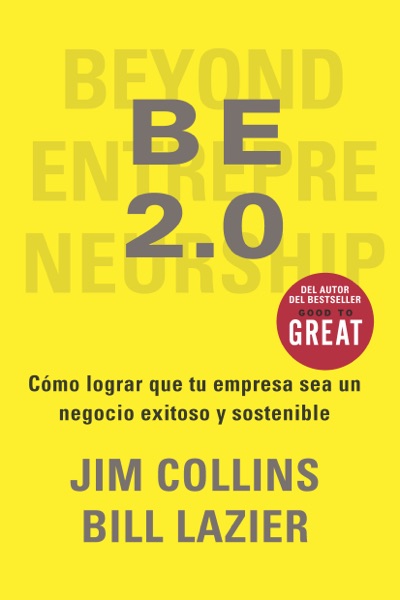
Beyond Entrepreneurship by Jim Collins & William Lazier is a 1992 business book about leadership, strategy, company building. The transition from entrepreneurial company to enduring institution requires replacing founder-energy with systems, vision, and leadership discipline. Hustle cannot substitute forever.
Summary
Beyond Entrepreneurship is Jim Collins's first major book, co-written with William Lazier and published in 1992, before the research that produced Built to Last and Good to Great. It is aimed at leaders of small and mid-sized companies who need to move beyond the founder's hustle to build something more deliberate and lasting. While Collins's later books are research-driven and comparative, this one is prescriptive and practical — closer to a manual than a study.
The book is organized around five core disciplines: leadership, vision, strategy, innovation, and tactical excellence. Collins and Lazier argue that most entrepreneurial companies hit a ceiling not because they lack ideas or capital but because the founder's personal energy can no longer substitute for systems, and because the organization hasn't developed a clear vision that guides decisions when the founder isn't in the room. The move from entrepreneurial company to enduring institution requires deliberate work in each of these five areas.
The vision section is particularly strong and anticipates themes Collins would develop more fully in Built to Last. He argues that vision consists of three elements: core values (what you believe), purpose (why you exist beyond profit), and mission (what you're specifically trying to accomplish). These are not interchangeable, and many companies confuse them. A core value, properly understood, is something you'd preserve even if it became a competitive disadvantage. Most things companies call core values are actually strategies or preferences.
In 2020, Collins published an updated and expanded version of the book, subtitled "2.0," incorporating new material and revisions in light of his later research. The original 1992 text is most valuable as a window into Collins's thinking before Good to Great, and for the directness of its prescriptive advice. For small company leaders, it is often more actionable than the comparative research books, which are primarily useful for diagnosis rather than instruction.
Talk to Beyond Entrepreneurship like its author wrote you back.
Get the ideas that fit your life — not generic summaries.
- Chat with the book
- Audiobook-style main ideas
- Adapts to your life and goals
- Helps you take action
Key takeaways
- 1.
The transition from entrepreneurial company to enduring institution requires replacing founder-energy with systems, vision, and leadership discipline. Hustle cannot substitute forever.
- 2.
Vision consists of three distinct elements: core values (what you truly believe), purpose (why you exist), and mission (what you're specifically doing now). Most companies conflate these to their detriment.
- 3.
A core value is a principle you'd preserve even if it became a competitive disadvantage. If you'd abandon it under pressure, it's a preference or strategy, not a value.
- 4.
Strategy should start with understanding what your organization is uniquely good at, what it can genuinely be best in the world at, and what drives its economic engine. This 'hedgehog concept' appears in early form here before Good to Great.
- 5.
Leadership at the entrepreneurial stage is about personal energy and vision. Leadership at the institutional stage is about creating an environment where others can lead. The skills required are genuinely different.
- 6.
Innovation must be systematic, not accidental. Collins argues that enduring companies build formal processes for innovation rather than depending on inspired moments from exceptional individuals.
- 7.
Tactical excellence — the ability to execute well day-to-day — is as important as strategy and vision, and is more often neglected because it is less glamorous to talk about.
- 8.
The best leaders of enduring companies combine genuine humility about what they don't know with fierce, unwavering commitment to the core values and mission.
Discussion questions
Use these on your own, with a book club, or as chat starters in Superbook. Book club version, ready to copy or print →
- 1.
Collins distinguishes core values, purpose, and mission as three elements of vision. In an organization you know well, which of these three is clearest? Which is most confused with the others?
- 2.
The book argues that hustle cannot substitute indefinitely for systems and discipline. Have you seen a company — or been at one — that hit exactly this ceiling? What happened?
- 3.
A true core value is something you'd preserve even at competitive cost. Can you name one value you personally hold that meets this test? Can an organization hold such a value?
- 4.
Collins's prescriptions in this book are more direct than in his research books. Do you find prescriptive advice from practitioners more or less useful than pattern-matched research from studies?
- 5.
The five disciplines — leadership, vision, strategy, innovation, tactical excellence — are each assigned a chapter. In organizations you've led or worked in, which of the five tends to get the least attention?
- 6.
This was Collins's first major book, predating his research on Built to Last and Good to Great. Reading it, can you see the seeds of ideas he developed more fully later?
- 7.
The vision framework predates the Hedgehog Concept from Good to Great. Do you think this earlier version is more or less useful for practical application?
- 8.
Collins argues that innovation must be systematic rather than accidental. What does a genuine system for innovation look like in a company of, say, 50 people?
- 9.
The book is aimed at small and mid-sized company leaders. How much of its advice applies to large organizations, government agencies, or nonprofits?
- 10.
Collins writes about the transition from founder-led to institution-led. What's the hardest thing for a founder to give up, and what's typically the last thing they let go?
- 11.
Tactical excellence is described as underinvested because it's unglamorous. What tactical execution detail has had the highest leverage in an organization you've been part of?
Themes
Frequently asked questions
-
Is Beyond Entrepreneurship still worth reading given Collins's later work?
Yes for entrepreneurs and small company leaders who want direct prescription rather than comparative research. The 2020 updated edition is the recommended version. For readers who've already read Good to Great and Built to Last, this book fills in how Collins developed those frameworks and offers more operational guidance.
-
How does Beyond Entrepreneurship relate to Good to Great?
It's the precursor. Many concepts Collins developed more rigorously in Good to Great — the Hedgehog Concept, Level 5 leadership, the flywheel — appear here in earlier, more prescriptive form. Reading both reveals how the ideas evolved as Collins moved from prescriptive to research-driven.
-
What is the most actionable idea in the book?
The three-part vision framework: separate your core values from your purpose from your mission. Many leadership teams that think they have a clear vision actually have three different things tangled together, and separating them clarifies decision-making significantly.
-
Who is this book most useful for?
Founders and CEOs of companies between roughly 10 and 500 people who need to move beyond founder-mode operations. The prescriptive format serves that audience better than Collins's research-heavy later books, which are more useful for diagnosis than instruction.
-
How long is Beyond Entrepreneurship?
The updated 2020 edition runs around 320 pages. At average reading pace, roughly five to six hours. The book is organized thematically and the chapters can be read somewhat independently for those focused on specific challenges.
Similar books
Good to Great
Jim Collins
Built to Last: Successful Habits of Visionary Companies
Jim Collins and Jerry I. Porras
The Hard Thing About Hard Things
Ben Horowitz
High Output Management
Andrew S. Grove
