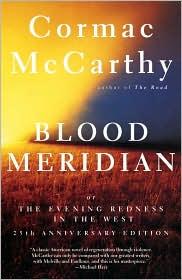
Talk to Blood Meridian like its author wrote you back.
Get the ideas that fit your life — not generic summaries.
- Chat with the book
- Audiobook-style main ideas
- Adapts to your life and goals
- Helps you take action
What it argues
Blood Meridian, or The Evening Redness in the West is set along the Texas-Mexico border in the 1840s and loosely follows a teenage runaway known only as the kid, who falls in with the Glanton gang — a historical band of scalp hunters hired by the Mexican government to kill Apache raiders. What ensues is among the most sustained depictions of violence in American literature: the gang kills indiscriminately, collects bounties on Mexican and Apache alike, and descends into something beyond lawlessness. Overseeing it all is Judge Holden, one of the most discussed and disturbing figures in contemporary fiction.
The novel is primarily a philosophical argument conducted through image and event rather than dialogue or interior monologue. The Judge is its engine — an enormous, hairless man of terrifying intelligence and physical power who argues, explicitly and relentlessly, that war is the ultimate human expression, that violence is not aberrant but fundamental. McCarthy refuses to provide a counterweight. There is no reliable moral center, no character whose perspective anchors the horror as horror. The kid has faint, unexplained resistances, but the novel doesn't let them redeem him or anyone else. This is its great difficulty and also, for many readers, its greatness.
What it gets right
- 1.
Judge Holden argues that war is the truest expression of human will. The novel doesn't refute him — it withholds an easy rebuttal and forces the reader to construct one, if they can.
- 2.
McCarthy roots the novel in historical fact: the Glanton gang was real, the massacres documented. The novel uses historical horror to interrogate the mythology America built over it.
- 3.
The kid's faint moral resistances — small, unexplained moments of hesitation — are the closest the novel comes to a conscience. They are not enough.
What it covers
Who wrote it
Cormac McCarthy (1933–2023) was an American novelist widely regarded as one of the greatest prose stylists in the language. His novels include the Border Trilogy (All the Pretty Horses, The Crossing, Cities of the Plain), No Country for Old Men, The Road, and Suttree. The Road won the Pulitzer Prize for Fiction in 2007. McCarthy spent decades writing in relative obscurity before Blood Meridian (1985) established his place in the canon. He was famously private and gave very few interviews across his career.
