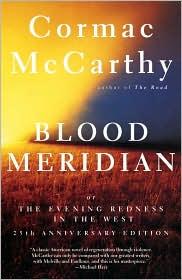
Blood Meridian by Cormac McCarthy is a 1985 literary fiction book about violence and human nature, manifest destiny, fate and free will. Judge Holden argues that war is the truest expression of human will. The novel doesn't refute him — it withholds an easy rebuttal and forces the reader to construct one, if they can.
Summary
Blood Meridian, or The Evening Redness in the West is set along the Texas-Mexico border in the 1840s and loosely follows a teenage runaway known only as the kid, who falls in with the Glanton gang — a historical band of scalp hunters hired by the Mexican government to kill Apache raiders. What ensues is among the most sustained depictions of violence in American literature: the gang kills indiscriminately, collects bounties on Mexican and Apache alike, and descends into something beyond lawlessness. Overseeing it all is Judge Holden, one of the most discussed and disturbing figures in contemporary fiction.
The novel is primarily a philosophical argument conducted through image and event rather than dialogue or interior monologue. The Judge is its engine — an enormous, hairless man of terrifying intelligence and physical power who argues, explicitly and relentlessly, that war is the ultimate human expression, that violence is not aberrant but fundamental. McCarthy refuses to provide a counterweight. There is no reliable moral center, no character whose perspective anchors the horror as horror. The kid has faint, unexplained resistances, but the novel doesn't let them redeem him or anyone else. This is its great difficulty and also, for many readers, its greatness.
McCarthy's prose style is one of the most distinctive in American fiction — long, unpunctuated sentences, biblical cadences, violence described with the precision and calm of natural history. The landscape is as central as any character: the Sonoran desert rendered in exhausting, hypnotic detail. McCarthy read widely in the historical record to construct the novel's setting; the Glanton gang was real, the atrocities documented. Blood Meridian refuses to let American mythology — the frontier, manifest destiny, civilization's westward expansion — stand without accounting for what it was built on.
This is not a novel for every reader and McCarthy does not pretend otherwise. The violence is not cathartic, not contained, not placed in service of redemption. Readers seeking moral clarity will find none. Readers who want to understand why Blood Meridian appears on so many lists of the greatest American novels — Harold Bloom called it the greatest — will need to sit with the Judge's monologues and let the cumulative weight of the prose do its work. It is not an enjoyable book in any conventional sense. It is, by most serious assessments, an extraordinary one.
Talk to Blood Meridian like its author wrote you back.
Get the ideas that fit your life — not generic summaries.
- Chat with the book
- Audiobook-style main ideas
- Adapts to your life and goals
- Helps you take action
Key takeaways
- 1.
Judge Holden argues that war is the truest expression of human will. The novel doesn't refute him — it withholds an easy rebuttal and forces the reader to construct one, if they can.
- 2.
McCarthy roots the novel in historical fact: the Glanton gang was real, the massacres documented. The novel uses historical horror to interrogate the mythology America built over it.
- 3.
The kid's faint moral resistances — small, unexplained moments of hesitation — are the closest the novel comes to a conscience. They are not enough.
- 4.
McCarthy's prose style performs the violence as much as it describes it: long cadences that carry the reader through atrocity without pause force a kind of complicity.
- 5.
The desert landscape isn't backdrop — it's an argument. Nature is indifferent, beautiful, and murderous in equal measure.
- 6.
Blood Meridian belongs to a tradition of American literature that refuses to separate civilization from the violence required to establish it.
- 7.
The Judge's final appearance is one of the most debated endings in postwar American fiction. McCarthy offers no interpretation.
- 8.
The novel challenges the reader to distinguish between depicting violence and endorsing it — a question it raises without resolving.
Discussion questions
Use these on your own, with a book club, or as chat starters in Superbook. Book club version, ready to copy or print →
- 1.
Judge Holden argues that war is god, and that those who worship something else are merely waiting to find out. Does the novel endorse this view, or is it simply allowing him to speak?
- 2.
The kid has moments where he seems to resist. Are those moments meaningful, or does McCarthy show they change nothing? Does the novel think moral hesitation matters?
- 3.
The Glanton gang's victims include people the novel doesn't name or individualize. Is that a failure of moral imagination or a deliberate technique — and what does it achieve?
- 4.
McCarthy drew from historical sources. Knowing the Glanton gang was real changes the reading — does it make the novel more or less bearable? More or less important?
- 5.
The prose style is almost liturgical at times — biblical rhythm applied to mass murder. What does that tonal juxtaposition accomplish? Is it earned?
- 6.
Harold Bloom called Blood Meridian the greatest American novel of the second half of the twentieth century. What would you have to believe about fiction to agree with that?
- 7.
The novel never provides a clear moral framework. Is the absence of judgment the point, or does McCarthy lose something by refusing to take a position?
- 8.
The ending is notoriously opaque. What do you think happens, and does it matter?
- 9.
Blood Meridian is often read alongside the Western genre — John Ford, Louis L'Amour, the mythology of the frontier. What does it do to that mythology?
- 10.
The Judge seems to know he is being watched, observed, even written. Is he a character, or something else — an idea, a force, a metafictional figure?
- 11.
How does this novel compare to McCarthy's Border Trilogy (which starts with All the Pretty Horses) in terms of tone and moral vision?
- 12.
Can you name the last time you read violence depicted with this precision? What is the effect of McCarthy's refusal to look away?
Themes
Frequently asked questions
-
Is Blood Meridian worth reading?
Depends entirely on what you want from a novel. If you can engage with fiction as philosophical argument — and if sustained, unflinching violence won't cause you to put it down — then yes, it is one of the most powerful American novels ever written. If you need moral scaffolding or redemptive arcs, this book will feel like punishment.
-
Is Blood Meridian hard to read?
Yes, in several ways. The prose is dense and uses no quotation marks for dialogue, making it initially disorienting. The violence is relentless and described without emotional distancing. And the novel offers no interpretive guidance — you're left with the Judge's arguments and McCarthy's images, and you have to make of them what you can.
-
Who is the Judge, exactly?
Judge Holden is a historical figure (mentioned briefly in real accounts of the Glanton gang) whom McCarthy transforms into something almost mythological. He appears to be ageless, speaks multiple languages, has encyclopedic knowledge, and argues explicitly that violence is the supreme human expression. He is the most discussed character in McCarthy's fiction.
-
Who shouldn't read Blood Meridian?
Anyone sensitive to graphic violence, anyone seeking moral resolution or redemptive narrative, and anyone who finds McCarthy's unpunctuated, unbroken prose style an obstacle rather than an invitation. The novel is genuinely hostile to comfortable reading.
-
Is there a film adaptation?
Not yet — Blood Meridian has been in development hell for decades. Directors including Tommy Lee Jones, Todd Field, and Ridley Scott have been attached at various points. The violence and the Judge are considered nearly unfilmable. As of 2025, no adaptation has been produced.