Talk to Blue Ocean Strategy like its author wrote you back.
Get the ideas that fit your life — not generic summaries.
- Chat with the book
- Audiobook-style main ideas
- Adapts to your life and goals
- Helps you take action
What it argues
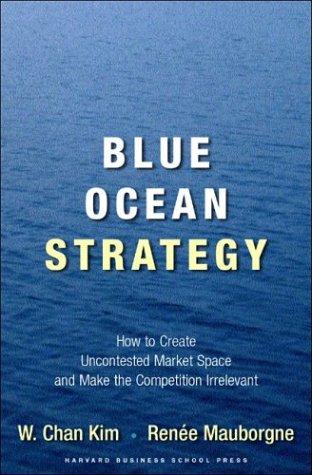
Blue Ocean Strategy is Kim and Mauborgne's case that the most successful companies don't compete in existing markets by beating rivals at their own game — they create new market spaces where competition is irrelevant. A "red ocean" is an existing, defined market where competitors fight over the same customers by differentiating on the same dimensions. A "blue ocean" is market space that doesn't yet exist, created by redefining the problem rather than solving it more efficiently than the competition.
The authors draw on a study of 150 strategic moves across thirty industries over a hundred years to argue that the companies behind the biggest value-creating growth didn't just outperform their rivals — they made the competition irrelevant by changing the rules. Cirque du Soleil is the most memorable example: instead of competing for the shrinking traditional circus audience, it created a new kind of entertainment that borrowed elements from theater and circus to attract adults who wouldn't otherwise go to a circus.
What it gets right
- 1.
Red oceans are existing competitive markets where rivals fight over the same customers. Blue oceans are new market spaces where competition is irrelevant because the market doesn't yet exist.
- 2.
The most successful strategic moves don't outperform the competition — they redefine the problem and change the value dimensions that customers care about.
- 3.
The Strategy Canvas maps how an industry performs across value dimensions, revealing where everyone has converged and where blue ocean moves are available.
What it covers
Who wrote it
W. Chan Kim and Renée Mauborgne are professors at INSEAD and co-directors of the INSEAD Blue Ocean Strategy Institute. Their research on strategy, value innovation, and growth has been cited by practitioners at major corporations and government agencies. Blue Ocean Strategy, originally published in 2005 and updated in an expanded edition in 2015, has sold more than four million copies and has been translated into forty-six languages. Their follow-up book, Blue Ocean Shift, addresses the practical process of moving from red to blue ocean strategy.
