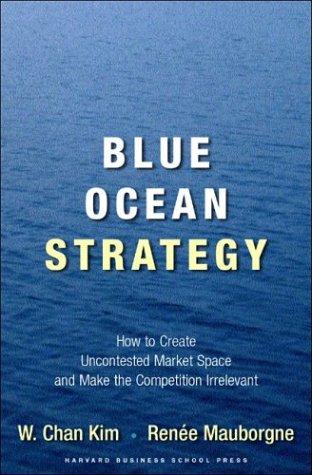
Blue Ocean Strategy by W. Chan Kim and Renée Mauborgne is a 2005 business book about strategy, innovation, market creation. Red oceans are existing competitive markets where rivals fight over the same customers. Blue oceans are new market spaces where competition is irrelevant because the market doesn't yet exist.
Summary
Blue Ocean Strategy is Kim and Mauborgne's case that the most successful companies don't compete in existing markets by beating rivals at their own game — they create new market spaces where competition is irrelevant. A "red ocean" is an existing, defined market where competitors fight over the same customers by differentiating on the same dimensions. A "blue ocean" is market space that doesn't yet exist, created by redefining the problem rather than solving it more efficiently than the competition.
The authors draw on a study of 150 strategic moves across thirty industries over a hundred years to argue that the companies behind the biggest value-creating growth didn't just outperform their rivals — they made the competition irrelevant by changing the rules. Cirque du Soleil is the most memorable example: instead of competing for the shrinking traditional circus audience, it created a new kind of entertainment that borrowed elements from theater and circus to attract adults who wouldn't otherwise go to a circus.
The book's main analytical tool is the Strategy Canvas — a line chart that plots how a company or industry performs across the dimensions that buyers care about. Drawing the strategy canvas for an industry reveals where all competitors have converged on the same value dimensions, which makes the blue ocean moves visible: eliminate dimensions that the industry takes for granted but that add cost without customer value, reduce others below industry standards, raise a few well above, and create entirely new dimensions no one offers. This four-actions framework is the central methodology.
The strategy canvas and four-actions framework are genuinely useful analytical tools, and several chapters on execution and overcoming organizational resistance are more practical than the book's reputation suggests. The honest limitation is that "create a new market" is much easier to identify in retrospect than to specify in advance, and the book is stronger as a diagnostic lens than as a how-to guide for which specific blue oceans to pursue.
Talk to Blue Ocean Strategy like its author wrote you back.
Get the ideas that fit your life — not generic summaries.
- Chat with the book
- Audiobook-style main ideas
- Adapts to your life and goals
- Helps you take action
Key takeaways
- 1.
Red oceans are existing competitive markets where rivals fight over the same customers. Blue oceans are new market spaces where competition is irrelevant because the market doesn't yet exist.
- 2.
The most successful strategic moves don't outperform the competition — they redefine the problem and change the value dimensions that customers care about.
- 3.
The Strategy Canvas maps how an industry performs across value dimensions, revealing where everyone has converged and where blue ocean moves are available.
- 4.
The four-actions framework: Eliminate dimensions the industry takes for granted, Reduce others below standard, Raise a few above standard, Create entirely new dimensions — generating both differentiation and lower cost simultaneously.
- 5.
Value innovation is the cornerstone of blue ocean strategy: pursuing differentiation and low cost at the same time rather than choosing between them.
- 6.
Blue oceans are not just about technology innovation — they can be found by looking across industries, buyer groups, product complements, or emotional vs. functional appeals.
- 7.
The Pioneer-Migrator-Settler map assesses a portfolio by whether each business is creating new market space (pioneers), offering improvements (migrators), or competing conventionally (settlers).
- 8.
Execution of blue ocean strategy requires tipping point leadership: concentrate change resources on the factors that most influence behavior rather than trying to change everything equally.
Discussion questions
Use these on your own, with a book club, or as chat starters in Superbook. Book club version, ready to copy or print →
- 1.
Kim and Mauborgne argue you should pursue differentiation and low cost simultaneously, not trade one off against the other. When have you seen a company successfully do this?
- 2.
Draw a rough strategy canvas for an industry you know well. Where is every competitor offering the same thing? That's where the blue ocean opportunity may be.
- 3.
The Cirque du Soleil example works because they rejected the industry's assumptions. What assumptions does your field take for granted that a new entrant could profitably challenge?
- 4.
Blue oceans are much easier to identify in hindsight than in foresight. What makes it difficult to see them prospectively, and what tools might help?
- 5.
The four-actions framework asks you to eliminate things the industry takes for granted. What would you eliminate from your own product or service if you started from scratch?
- 6.
When is competing in a red ocean the right strategy? Not every market can or should be redefined — when is winning within the existing competitive structure the smarter choice?
- 7.
The book draws examples from industries as varied as wine, automobiles, and circus entertainment. Does the blue ocean framework apply equally well to B2B and B2C, or does it fit one better?
- 8.
Kim and Mauborgne say blue ocean strategy should create new demand, not steal it from competitors. How do you tell whether a new product is truly creating new demand or just displacing existing purchases?
- 9.
The strategy canvas requires choosing which value dimensions to map. How do you decide which dimensions matter, and who gets to decide?
- 10.
What are the organizational barriers to pursuing a blue ocean strategy inside a large company, and how would you address them?
- 11.
How has the rise of digital platforms and network effects changed the dynamics of blue ocean strategy since the first edition in 2005?
- 12.
What's a blue ocean that has since become a red ocean as competitors entered? What does that trajectory tell you about the durability of market-creation strategies?
Themes
Frequently asked questions
-
Is Blue Ocean Strategy still relevant?
Yes. The core insight — that value innovation is more powerful than conventional competition — holds up. The strategy canvas is a practical analytical tool. The specific examples have dated somewhat, but the updated 2015 edition adds more contemporary cases.
-
What is value innovation in Blue Ocean Strategy?
Value innovation is the simultaneous pursuit of differentiation and lower cost — breaking the tradeoff that conventional strategy assumes. It's achieved by eliminating and reducing the factors your industry competes on (lowering cost) while raising and creating others that matter to a new buyer group (increasing value).
-
How do I find a blue ocean?
The book offers six paths: look across alternative industries, look across strategic groups, look across buyer chains, look across complementary products, look across functional-emotional appeal, and look across time. Each is a lens for questioning what your industry currently takes for granted.
-
Who should read Blue Ocean Strategy?
Strategy leaders, product managers, and entrepreneurs who want a framework for differentiation that goes beyond incremental improvement. Most useful when you're trying to decide which markets to enter or how to reposition a product that's losing on conventional competitive dimensions.
-
Does Blue Ocean Strategy work for small companies?
The framework is scale-neutral — small companies have used it to find niches that larger competitors ignore. The examples in the book skew large, but the analytical tools are applicable to any company trying to identify uncontested market space.
Similar books
Competitive Strategy
Michael E. Porter
The Innovator's Dilemma
Clayton M. Christensen
Playing to Win: How Strategy Really Works
Roger L. Martin and A.G. Lafley
Crossing the Chasm
Geoffrey A. Moore
