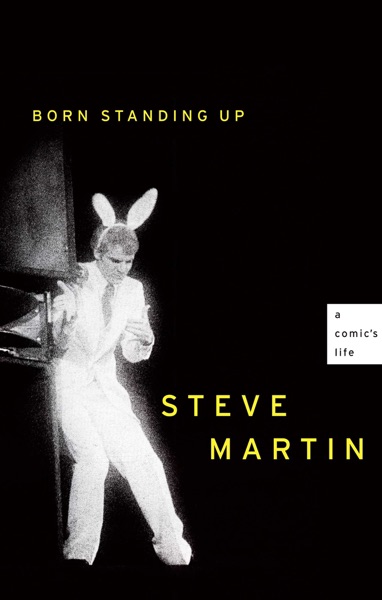
Talk to Born Standing Up like its author wrote you back.
Get the ideas that fit your life — not generic summaries.
- Chat with the book
- Audiobook-style main ideas
- Adapts to your life and goals
- Helps you take action
What it argues
Born Standing Up is Steve Martin's account of the decade-long grind that preceded his sudden, seemingly overnight fame as America's biggest stand-up comedian of the late 1970s. It is one of the most precise accounts of craft development ever written by a performer — precise in the sense that Martin is willing to dissect what he was doing and why, not merely narrate what happened.
Martin spent his teenage years working at Disneyland and Knott's Berry Farm, where he learned magic tricks and how to read a crowd. He studied philosophy at Long Beach State and Stanford, which gave him the vocabulary to think about comedy theoretically. His act evolved over years of club and college dates that paid almost nothing, in front of audiences that ranged from receptive to hostile. He describes a deliberate decision to abandon conventional joke structure — setups and punchlines — in favor of an act that created a state of comedy, where the audience was in a heightened condition in which everything was funny. It took years before that decision paid off.
What it gets right
- 1.
Fame that appears sudden is almost always the result of years of unglamorous work done in obscurity, with no guarantee that it would ever pay off.
- 2.
Martin deliberately abandoned conventional joke structure and instead aimed to create a state of comedy — an atmosphere in which the audience was primed to find everything funny.
- 3.
Learning to perform in front of difficult audiences is irreplaceable training; comfortable rooms don't teach you what hostile rooms do.
What it covers
Who wrote it
Steve Martin is an American actor, comedian, playwright, and author who was one of the dominant stand-up comedians of the late 1970s before transitioning to film, theatre, and fiction. His films include Roxanne, L.A. Story, and Bowfinger. He wrote the plays Picasso at the Lapin Agile and Meteor Shower, and has published short fiction and essays collected in Pure Drivel and Cruel Shoes. He is also a serious banjo player and bluegrass composer. Born Standing Up, published in 2007, is his only memoir and is widely regarded as one of the best accounts of a performer's craft development ever written.
