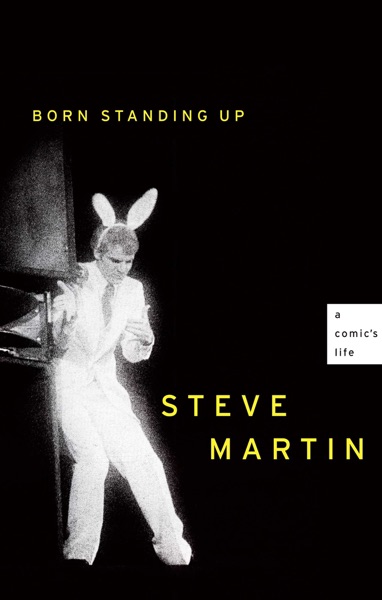
Born Standing Up by Steve Martin is a 2007 memoir book about comedy, craft, ambition. Fame that appears sudden is almost always the result of years of unglamorous work done in obscurity, with no guarantee that it would ever pay off.
Summary
Born Standing Up is Steve Martin's account of the decade-long grind that preceded his sudden, seemingly overnight fame as America's biggest stand-up comedian of the late 1970s. It is one of the most precise accounts of craft development ever written by a performer — precise in the sense that Martin is willing to dissect what he was doing and why, not merely narrate what happened.
Martin spent his teenage years working at Disneyland and Knott's Berry Farm, where he learned magic tricks and how to read a crowd. He studied philosophy at Long Beach State and Stanford, which gave him the vocabulary to think about comedy theoretically. His act evolved over years of club and college dates that paid almost nothing, in front of audiences that ranged from receptive to hostile. He describes a deliberate decision to abandon conventional joke structure — setups and punchlines — in favor of an act that created a state of comedy, where the audience was in a heightened condition in which everything was funny. It took years before that decision paid off.
The memoir traces the arc from confusion to mastery, but it does not prettify the process. Martin describes the father-son relationship with candor unusual for celebrity autobiography: a father who was withheld and competitive, who never said he was proud of his son's success, and a reconciliation that came only in the father's final months. He also describes the personal cost of stardom — a decade of performing two hundred nights a year and then not knowing who he was when the performing stopped.
The book is short, quiet in tone, and more melancholy than most readers expect from a comedian's memoir. Martin is not interested in showbiz gossip or name-dropping. He is interested in the work: how it was built, what it cost, and what it means to walk away from a form you mastered because you can no longer grow inside it.
Talk to Born Standing Up like its author wrote you back.
Get the ideas that fit your life — not generic summaries.
- Chat with the book
- Audiobook-style main ideas
- Adapts to your life and goals
- Helps you take action
Key takeaways
- 1.
Fame that appears sudden is almost always the result of years of unglamorous work done in obscurity, with no guarantee that it would ever pay off.
- 2.
Martin deliberately abandoned conventional joke structure and instead aimed to create a state of comedy — an atmosphere in which the audience was primed to find everything funny.
- 3.
Learning to perform in front of difficult audiences is irreplaceable training; comfortable rooms don't teach you what hostile rooms do.
- 4.
Studying philosophy gave Martin a framework for thinking about comedy analytically — why something is funny, not just whether it is.
- 5.
The creative life and the personal life rarely stay in balance during the years of maximum ambition. Something pays the cost.
- 6.
Walking away from mastery is its own kind of courage; continuing a form you've exhausted is a different kind of failure than never achieving it.
- 7.
A strained or withholding parental relationship can coexist with professional success for years before demanding resolution — and the resolution may come too late for the answers you wanted.
- 8.
The audiences at Disneyland, at small clubs, and at arenas are categorically different; the skills required overlap but are not the same thing.
Discussion questions
Use these on your own, with a book club, or as chat starters in Superbook. Book club version, ready to copy or print →
- 1.
Martin describes spending years developing an act with no certainty it would work. At what point would you have given up, and what would that say about your own risk tolerance?
- 2.
His decision to abandon punchlines in favor of a 'state of comedy' was a creative bet that took years to pay off. Can you think of a comparable creative gamble you've seen someone make — or made yourself?
- 3.
The father-son relationship sits at the center of the memoir. How did Martin's account change how you read the rest of his story?
- 4.
Martin studied philosophy partly to think more rigorously about comedy. Is there a field adjacent to your own work that would give you similar analytical tools?
- 5.
He describes the disorientation of achieving exactly what you wanted and not recognizing yourself in it. Have you experienced that, or seen it in others?
- 6.
Martin gives very little credit to luck and a great deal to deliberate craft development. Do you think that's an accurate account, or does it underestimate luck?
- 7.
He walked away from stand-up at the peak of his fame because he'd said everything he had to say in that form. How do you know when to move on from something you're good at?
- 8.
The memoir is relatively free of showbiz gossip and anecdote. Is that a virtue or a limitation for a celebrity memoir?
- 9.
Martin describes performing to hostile audiences as essential training. What's the equivalent of a hostile audience in your own field, and are you seeking it out?
- 10.
The tone of the book is more melancholy than funny. Does that match your expectation of a memoir by a comedian? What does the tone itself tell you about Martin?
- 11.
He says the hardest part of comedy is not being funny but figuring out what kind of comedy you are. Does that apply to any non-comedic work you do?
- 12.
Born Standing Up was written thirty years after the events it describes. What might Martin have gotten wrong or softened in retrospect?
Themes
Frequently asked questions
-
Is Born Standing Up worth reading if you're not a fan of Steve Martin?
Yes. The book is less about Martin's celebrity and more about the craft of building an original creative act from nothing. The lessons apply well beyond comedy — to any field where you're trying to develop a distinct voice and work ethic in obscurity before anyone is watching.
-
How long is Born Standing Up?
Around 200 pages, roughly three to four hours of reading. It's notably short for a celebrity memoir, which suits the material — Martin doesn't pad it with anecdote or name-dropping.
-
What makes this memoir different from other celebrity autobiographies?
Martin is unusually analytical about his own work. Rather than narrating success, he dissects the creative decisions behind it: why he abandoned punchlines, how he read different audiences, what studying philosophy taught him about comedic structure. The father-son thread gives it emotional weight beyond the showbiz story.
-
Does the book cover Martin's film career?
No. It covers only the stand-up years, roughly from the mid-1960s through 1981. His film career, his art collecting, and his later theatrical work are almost entirely absent. This is a book about a specific decade and a specific craft.
-
Who should read Born Standing Up?
Anyone interested in craft development, creative ambition, or the psychology of performance. It is also quietly useful for people navigating a difficult relationship with a parent — Martin handles that thread with care.