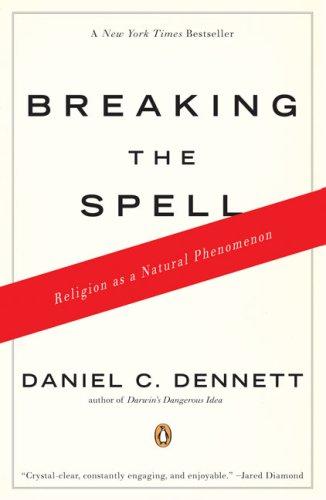
Talk to Breaking the Spell: Religion as a Natural Phenomenon like its author wrote you back.
Get the ideas that fit your life — not generic summaries.
- Chat with the book
- Audiobook-style main ideas
- Adapts to your life and goals
- Helps you take action
What it argues
Breaking the Spell is Daniel Dennett's case that religion is a natural phenomenon — one that can and should be studied using the methods of evolutionary biology, cognitive science, and anthropology. The spell in the title is the widespread belief that religion is too important, too sacred, or too dangerous to subject to scientific scrutiny. Dennett argues that breaking this spell is not disrespectful but necessary, both for intellectual honesty and for making informed collective decisions about the role of religion in public life.
The first half of the book is methodological. Dennett assembles a picture of how religions emerge and persist, drawing on evolutionary theory of cultural transmission, cognitive science of agent detection, and the anthropology of ritual. His central argument borrows from meme theory: religions are cultural entities that have evolved to replicate and resist competition. The features that seem most characteristic of religion — strong emotional resonance, community reinforcement, promises of transcendence, opposition to apostasy — are exactly the features that would be selected for in a replicating cultural unit competing for human minds.
What it gets right
- 1.
Religion is a natural phenomenon: it arose through ordinary evolutionary and cognitive mechanisms, not divine intervention, and can be studied empirically.
- 2.
The 'spell' is the cultural taboo against applying scientific scrutiny to religious belief. Dennett argues breaking it is necessary for honest public discourse.
- 3.
Agent detection — the tendency to perceive intent behind natural events — is a cognitive bias that, once extended to the cosmos, predisposes humans toward religious belief.
What it covers
Who wrote it
Daniel C. Dennett is an American philosopher and cognitive scientist, and co-director of the Center for Cognitive Studies at Tufts University. His books include Consciousness Explained, Darwin's Dangerous Idea, and From Bacteria to Bach and Back. A longtime proponent of philosophical naturalism, Dennett argues that the tools of science and evolutionary biology are sufficient to explain mind, consciousness, and culture without invoking the supernatural. He was widely identified as one of the New Atheists in the mid-2000s, though his approach to religion is more analytical than polemical.
