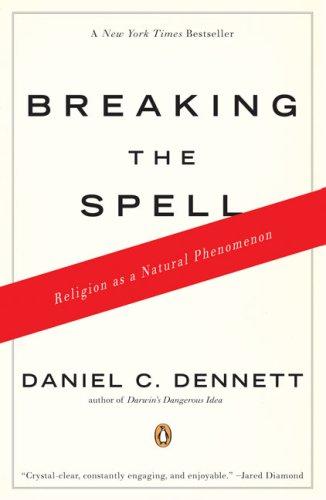
Breaking the Spell: Religion as a Natural Phenomenon by Daniel C. Dennett is a 2006 philosophy book about religion, evolution, naturalism. Religion is a natural phenomenon: it arose through ordinary evolutionary and cognitive mechanisms, not divine intervention, and can be studied empirically.
Summary
Breaking the Spell is Daniel Dennett's case that religion is a natural phenomenon — one that can and should be studied using the methods of evolutionary biology, cognitive science, and anthropology. The spell in the title is the widespread belief that religion is too important, too sacred, or too dangerous to subject to scientific scrutiny. Dennett argues that breaking this spell is not disrespectful but necessary, both for intellectual honesty and for making informed collective decisions about the role of religion in public life.
The first half of the book is methodological. Dennett assembles a picture of how religions emerge and persist, drawing on evolutionary theory of cultural transmission, cognitive science of agent detection, and the anthropology of ritual. His central argument borrows from meme theory: religions are cultural entities that have evolved to replicate and resist competition. The features that seem most characteristic of religion — strong emotional resonance, community reinforcement, promises of transcendence, opposition to apostasy — are exactly the features that would be selected for in a replicating cultural unit competing for human minds.
The second half moves toward recommendations. Dennett argues that religious institutions should be subject to the same transparency and accountability standards as other powerful social institutions, particularly when they influence public health or education. He proposes that children should be given what he calls a "neutral" education about world religions before being initiated into any single tradition. These recommendations are more tentative than the descriptive analysis that precedes them, and Dennett seems aware of how contested they are.
Breaking the Spell is longer and more philosophically careful than the other New Atheist texts it's typically grouped with. Dennett is not primarily interested in attacking religion; he is interested in understanding it. He repeatedly acknowledges that religion may have provided genuine goods — community, moral scaffolding, comfort in grief — even if its metaphysical claims are false. The book's weakness is pacing: the methodological chapters are dense and the middle sections lose momentum. But the argument is serious, the framework is illuminating, and Dennett's willingness to sit with complexity sets it apart from most books in its category.
Talk to Breaking the Spell: Religion as a Natural Phenomenon like its author wrote you back.
Get the ideas that fit your life — not generic summaries.
- Chat with the book
- Audiobook-style main ideas
- Adapts to your life and goals
- Helps you take action
Key takeaways
- 1.
Religion is a natural phenomenon: it arose through ordinary evolutionary and cognitive mechanisms, not divine intervention, and can be studied empirically.
- 2.
The 'spell' is the cultural taboo against applying scientific scrutiny to religious belief. Dennett argues breaking it is necessary for honest public discourse.
- 3.
Agent detection — the tendency to perceive intent behind natural events — is a cognitive bias that, once extended to the cosmos, predisposes humans toward religious belief.
- 4.
Religions function like biological organisms in an evolutionary sense: they replicate, mutate, compete, and develop defenses against extinction.
- 5.
Folk religion (what most people actually believe and practice) differs substantially from official doctrine, and any study of religion has to grapple with both.
- 6.
The benefits religion provides — community, ritual, meaning in crisis — are real and should not be dismissed. The question is whether they require the metaphysical claims to be true.
- 7.
Children being raised in a religion cannot meaningfully consent to the beliefs they are being given. Dennett argues this raises a genuine ethical question.
- 8.
Stealth religion — the migration of religious assumptions into secular institutions and policy debates — deserves the same scrutiny as explicit religious advocacy.
Discussion questions
Use these on your own, with a book club, or as chat starters in Superbook. Book club version, ready to copy or print →
- 1.
Dennett says that studying religion scientifically is not inherently disrespectful. Do you agree? Where does the line fall between analysis and desecration?
- 2.
He argues that the persistence of religion is better explained by evolution and cognitive bias than by truth. Does an explanation of why we believe something affect whether we think the belief is justified?
- 3.
What is a genuine benefit religion has provided in your community or family? Does identifying that benefit require accepting any theological claim?
- 4.
Dennett proposes that children should receive a neutral education about world religions before any religious initiation. Is that feasible, and is it actually neutral?
- 5.
He distinguishes folk religion from doctrinal religion. Which of those does he actually engage with, and which should he engage with more?
- 6.
The meme framework suggests religions spread because they are good at spreading, not because they are true. Does that frame feel illuminating or reductive to you?
- 7.
If the community and comfort functions of religion could be provided by secular institutions, would that weaken the case for religion? Why or why not?
- 8.
Dennett says religious moderates provide cover for extremists by making faith itself culturally untouchable. Do you find that argument persuasive?
- 9.
How does Dennett's treatment of religion compare to how he'd want evolution or climate science to be treated? Is the comparison apt?
- 10.
What would it mean for a religious institution to meet the transparency standards Dennett thinks are appropriate? Which institutions already come close?
- 11.
He worries about stealth religion in public policy. Can you identify a recent example where religious assumptions shaped a secular-seeming debate?
- 12.
Is there anything Breaking the Spell cannot explain about religion? What would a refutation of his framework need to show?
Themes
Frequently asked questions
-
What is Breaking the Spell about?
It's a philosophical and scientific investigation into why religion exists and how it spreads, treating religion as a natural cultural phenomenon subject to evolutionary and cognitive explanation. Dennett also argues for the removal of the taboo on studying religion scientifically.
-
How long does it take to read Breaking the Spell?
Around eight to nine hours. At roughly 400 pages it's the longest of the New Atheist books and the most philosophically dense. Some middle chapters are slow going, but the opening and closing sections are the clearest.
-
Is Breaking the Spell worth reading?
Worth reading if you want the most philosophically serious of the New Atheist books. It's less a polemic than an inquiry. If you want sharp provocation, Harris's books are shorter and faster. If you want a careful argument that respects the complexity of religious life, Dennett is the better choice.
-
Who should read Breaking the Spell?
Readers interested in the cognitive science and evolutionary biology of belief, those who want a serious secular engagement with religion that isn't purely hostile, and anyone studying philosophy of religion or cultural evolution.
-
What is Dennett's view on whether religion is harmful?
Nuanced. He acknowledges that religion has provided real goods — community, ritual, moral scaffolding — and doesn't dismiss these. His concern is that the metaphysical claims are not supported by evidence and that the taboo on examining them causes harm, particularly in public policy and education.