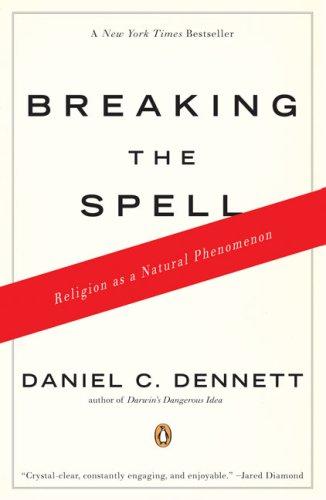
Talk to Breaking the Spell: Religion as a Natural Phenomenon like its author wrote you back.
Get the ideas that fit your life — not generic summaries.
- Chat with the book
- Audiobook-style main ideas
- Adapts to your life and goals
- Helps you take action
Breaking the Spell: Religion as a Natural Phenomenon, in detail
Breaking the Spell is Daniel Dennett's case that religion is a natural phenomenon — one that can and should be studied using the methods of evolutionary biology, cognitive science, and anthropology. The spell in the title is the widespread belief that religion is too important, too sacred, or too dangerous to subject to scientific scrutiny. Dennett argues that breaking this spell is not disrespectful but necessary, both for intellectual honesty and for making informed collective decisions about the role of religion in public life.
The first half of the book is methodological. Dennett assembles a picture of how religions emerge and persist, drawing on evolutionary theory of cultural transmission, cognitive science of agent detection, and the anthropology of ritual. His central argument borrows from meme theory: religions are cultural entities that have evolved to replicate and resist competition. The features that seem most characteristic of religion — strong emotional resonance, community reinforcement, promises of transcendence, opposition to apostasy — are exactly the features that would be selected for in a replicating cultural unit competing for human minds.
The second half moves toward recommendations. Dennett argues that religious institutions should be subject to the same transparency and accountability standards as other powerful social institutions, particularly when they influence public health or education. He proposes that children should be given what he calls a "neutral" education about world religions before being initiated into any single tradition. These recommendations are more tentative than the descriptive analysis that precedes them, and Dennett seems aware of how contested they are.
Breaking the Spell is longer and more philosophically careful than the other New Atheist texts it's typically grouped with. Dennett is not primarily interested in attacking religion; he is interested in understanding it. He repeatedly acknowledges that religion may have provided genuine goods — community, moral scaffolding, comfort in grief — even if its metaphysical claims are false. The book's weakness is pacing: the methodological chapters are dense and the middle sections lose momentum. But the argument is serious, the framework is illuminating, and Dennett's willingness to sit with complexity sets it apart from most books in its category.
The big ideas
- 1.
Religion is a natural phenomenon: it arose through ordinary evolutionary and cognitive mechanisms, not divine intervention, and can be studied empirically.
- 2.
The 'spell' is the cultural taboo against applying scientific scrutiny to religious belief. Dennett argues breaking it is necessary for honest public discourse.
- 3.
Agent detection — the tendency to perceive intent behind natural events — is a cognitive bias that, once extended to the cosmos, predisposes humans toward religious belief.
