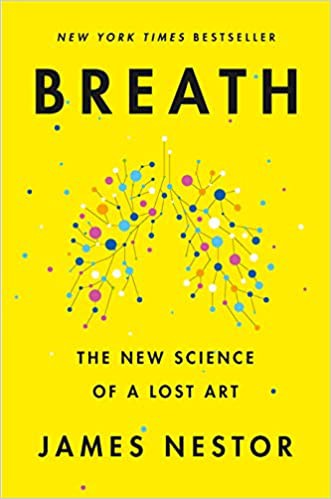
Talk to Breath: The New Science of a Lost Art like its author wrote you back.
Get the ideas that fit your life — not generic summaries.
- Chat with the book
- Audiobook-style main ideas
- Adapts to your life and goals
- Helps you take action
Breath: The New Science of a Lost Art, in detail
Breath is James Nestor's investigation into one of the most basic and overlooked aspects of human health: how we inhale and exhale. Nestor spent a decade reporting on pulmonology labs, free-diving records, ancient yogic texts, and Stanford clinical trials to reach a conclusion that sounds almost absurd: most people in the modern world are breathing wrong, and the consequences run from bad sleep to crooked teeth to anxiety disorders.
The book moves between Nestor's own experiments — including a Stanford study where researchers blocked his nose with silicone plugs for ten days to document the effects of mouth-breathing — and a wide cast of researchers, athletes, and practitioners who have spent careers studying breath. He traces how mouth-breathing became normalized through industrialization and processed food, how it reshaped the human skull and airway over generations, and why nasal breathing, slower exhalation, and breath retention have measurable effects on blood pressure, heart rate variability, and CO2 tolerance. The core physiological claim: most of us over-breathe, taking too many shallow breaths per minute, chronically expelling CO2 before tissues can absorb oxygen efficiently.
The second half shifts toward intervention. Nestor works through specific techniques: the Bohr effect, box breathing, the Buteyko method, Tummo, Sudarshan Kriya, and extended exhalations. Some are grounded in peer-reviewed research; others are supported mainly by practitioner testimony and Nestor's own self-experimentation. He is careful to note when the science is thin, which makes the more rigorous findings feel more credible. The practical prescription is surprisingly simple: breathe through your nose, slow the rate to around six breaths per minute, extend the exhale. These aren't exotic protocols — they're adjustments anyone can test in an afternoon.
Nestor writes like a science journalist rather than a wellness advocate, which keeps the book grounded when the material gets esoteric. He is candid about the limits of available research and avoids promising transformation. The result is a book that is genuinely surprising — not because the ideas are radical, but because something this fundamental has been so thoroughly ignored by mainstream medicine. The weaknesses are real: self-experimentation is not a clinical trial, and some chapters lean harder on anecdote than data. But for anyone who has ever snored, slept poorly, or dealt with chronic stress, Breath asks a question worth taking seriously.
The big ideas
- 1.
Most people breathe too fast, through their mouths, taking shallow chest breaths. This pattern chronically lowers CO2 levels and makes oxygen delivery to tissues less efficient.
- 2.
Nasal breathing filters air, humidifies it, and produces nitric oxide, which dilates blood vessels and has antimicrobial properties. Mouth-breathing provides none of these benefits.
- 3.
The Bohr effect explains why CO2 matters: hemoglobin releases oxygen to tissues only in the presence of sufficient carbon dioxide. Breathing less, paradoxically, can deliver more oxygen.
