Talk to Bubble in the Sun like its author wrote you back.
Get the ideas that fit your life — not generic summaries.
- Chat with the book
- Audiobook-style main ideas
- Adapts to your life and goals
- Helps you take action
Bubble in the Sun, in detail
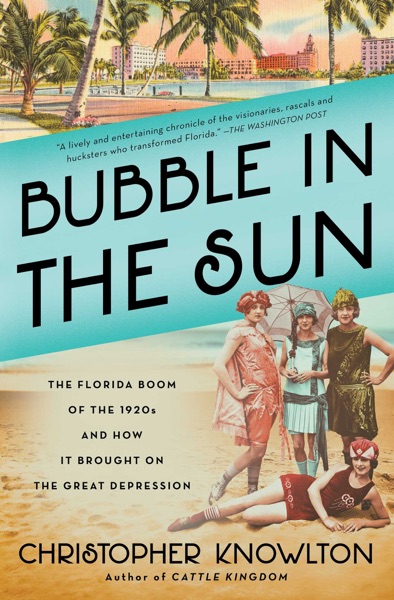
Bubble in the Sun is Christopher Knowlton's account of the Florida land boom of the 1920s, the single most spectacular speculative real estate bubble in American history before the 2000s. Between roughly 1920 and 1926, land prices in Florida — particularly in Miami, Palm Beach, and along the planned developments of men like Addison Mizner and George Merrick — rose at a pace that attracted speculators from across the country. At the boom's peak, a single lot could be resold multiple times in a single day. The bust, which arrived even before the 1929 crash, wiped out fortunes and left half-finished cities across the state.
Knowlton organizes the narrative around a cast of colorful central figures. Addison Mizner was a California architect with no formal training who invented the "Palm Beach Spanish" style that still defines much of South Florida's aesthetic and built Boca Raton from scratch as a planned luxury community. Carl Fisher was the Indianapolis motor entrepreneur who developed Miami Beach by dredging mangroves, importing soil, and marketing aggressively to the Midwest. George Merrick built Coral Gables, the most ambitious planned community of the era, with Mediterranean architecture, gondola canals, and an unrealized vision of a college town. D.P. Davis pulled off the audacious feat of creating two artificial islands in Tampa Bay and selling lots before the land was fully out of the water.
The boom was fed by infrastructure — the railroads of Flagler and Plant had opened Florida to northern tourists a generation earlier — and by a combination of genuine promise (the climate, the coastline) and classic speculative psychology: the belief that prices would rise indefinitely because everyone could see they were rising. What Knowlton captures well is how the mechanisms of bubble psychology work in practice. Buyers purchased "binders" — small deposits on lots — with the intention of selling before they had to pay the full price. The whole system depended on prices continuing upward and buyers continuing to appear.
The crash came from multiple directions: a series of hurricanes, the logistical impossibility of supplying a booming region through inadequate infrastructure, and the simple exhaustion of new buyers willing to pay ever-higher prices. Knowlton draws the parallels to subsequent bubbles — particularly 2005–2007 — without being heavy-handed about it. The book is most useful as a study of how rational individual decisions aggregate into irrational collective behavior, and as a reminder that Florida has always had a particular relationship with speculative excess.
The big ideas
- 1.
The Florida land boom of the 1920s was driven by a combination of real demographic and climate attractions and classic speculative psychology — the belief that prices could only rise because they had been rising.
- 2.
Binder boys — speculators who purchased small deposits on lots and sold them before the full payment was due — were the mechanism of the bubble's acceleration and its first indicator of collapse.
- 3.
The major developers (Mizner, Fisher, Merrick, Davis) mixed genuine vision with promotional excess. The physical infrastructure they created outlasted the financial structures that funded it.
