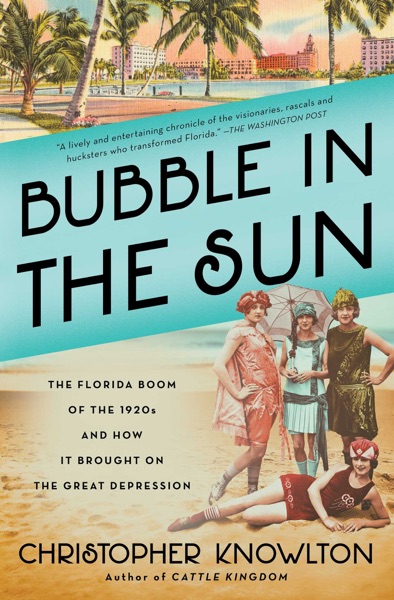
Bubble in the Sun by Christopher Knowlton is a 2020 history book about speculative bubbles, florida history, real estate. The Florida land boom of the 1920s was driven by a combination of real demographic and climate attractions and classic speculative psychology — the belief that prices could only rise because they had been rising.
Summary
Bubble in the Sun is Christopher Knowlton's account of the Florida land boom of the 1920s, the single most spectacular speculative real estate bubble in American history before the 2000s. Between roughly 1920 and 1926, land prices in Florida — particularly in Miami, Palm Beach, and along the planned developments of men like Addison Mizner and George Merrick — rose at a pace that attracted speculators from across the country. At the boom's peak, a single lot could be resold multiple times in a single day. The bust, which arrived even before the 1929 crash, wiped out fortunes and left half-finished cities across the state.
Knowlton organizes the narrative around a cast of colorful central figures. Addison Mizner was a California architect with no formal training who invented the "Palm Beach Spanish" style that still defines much of South Florida's aesthetic and built Boca Raton from scratch as a planned luxury community. Carl Fisher was the Indianapolis motor entrepreneur who developed Miami Beach by dredging mangroves, importing soil, and marketing aggressively to the Midwest. George Merrick built Coral Gables, the most ambitious planned community of the era, with Mediterranean architecture, gondola canals, and an unrealized vision of a college town. D.P. Davis pulled off the audacious feat of creating two artificial islands in Tampa Bay and selling lots before the land was fully out of the water.
The boom was fed by infrastructure — the railroads of Flagler and Plant had opened Florida to northern tourists a generation earlier — and by a combination of genuine promise (the climate, the coastline) and classic speculative psychology: the belief that prices would rise indefinitely because everyone could see they were rising. What Knowlton captures well is how the mechanisms of bubble psychology work in practice. Buyers purchased "binders" — small deposits on lots — with the intention of selling before they had to pay the full price. The whole system depended on prices continuing upward and buyers continuing to appear.
The crash came from multiple directions: a series of hurricanes, the logistical impossibility of supplying a booming region through inadequate infrastructure, and the simple exhaustion of new buyers willing to pay ever-higher prices. Knowlton draws the parallels to subsequent bubbles — particularly 2005–2007 — without being heavy-handed about it. The book is most useful as a study of how rational individual decisions aggregate into irrational collective behavior, and as a reminder that Florida has always had a particular relationship with speculative excess.
Talk to Bubble in the Sun like its author wrote you back.
Get the ideas that fit your life — not generic summaries.
- Chat with the book
- Audiobook-style main ideas
- Adapts to your life and goals
- Helps you take action
Key takeaways
- 1.
The Florida land boom of the 1920s was driven by a combination of real demographic and climate attractions and classic speculative psychology — the belief that prices could only rise because they had been rising.
- 2.
Binder boys — speculators who purchased small deposits on lots and sold them before the full payment was due — were the mechanism of the bubble's acceleration and its first indicator of collapse.
- 3.
The major developers (Mizner, Fisher, Merrick, Davis) mixed genuine vision with promotional excess. The physical infrastructure they created outlasted the financial structures that funded it.
- 4.
The boom collapsed before the 1929 crash, driven by hurricanes, infrastructure failure, and the simple mathematical end point of any scheme that requires ever-more buyers at ever-higher prices.
- 5.
The psychological mechanisms of the Florida bubble — social proof, fear of missing out, willingness to suspend skepticism during apparent prosperity — are recognizable in every subsequent real estate and asset bubble.
- 6.
Florida's unique geography (developable but fragile, appealing but risky) made it the natural site for repeated speculative cycles. The 1920s were the first large-scale instance of a pattern that recurred in the 1970s, 1990s, and 2000s.
- 7.
The developers who left the most lasting physical legacies — Mizner's architectural style, Merrick's Coral Gables plan — did so partly through the bubble's excess. The money available during the boom funded ambition that more conservative financing never would have.
Discussion questions
Use these on your own, with a book club, or as chat starters in Superbook. Book club version, ready to copy or print →
- 1.
The binder system allowed speculators to participate in rising prices without actually owning anything. What contemporary financial instruments have a similar structure of participating in gains without true ownership?
- 2.
Knowlton describes buyers who knew the prices were unsustainable but kept buying anyway. What mental mechanisms allow people to sustain that kind of cognitive dissonance during a bubble?
- 3.
The boom's promoters used advertising, celebrity testimonials, and staged events to create the impression of inevitable success. Where do you see those same promotional techniques applied in contemporary asset markets?
- 4.
The physical legacy of the Florida boom — the architecture, the canals, the planned communities — outlasted the financial collapse. Is there a meaningful distinction between financial bubbles that leave lasting infrastructure and those that don't?
- 5.
Several of the major developers were deeply in debt by the time the crash came. The boom required constant promotion precisely because the financing required constant new buyers. Does that structure sound familiar?
- 6.
The 1920s Florida bust happened before the Great Depression and had essentially no regulatory response. How do you think the availability (or absence) of federal intervention shapes bubble dynamics?
- 7.
Knowlton draws parallels to 2005–2007 without being heavy-handed. What did the 2000s Florida real estate bubble repeat from the 1920s, and what was genuinely different?
- 8.
The developers in the book were builders as well as promoters — they were creating something real, not just selling paper. Does that complicate how we should evaluate their role in the bubble?
- 9.
What attracts speculators to Florida specifically, repeatedly? Is there something about the geography or culture, or is it just that Florida happened to have the first big opportunity?
- 10.
The book ends with the crash and its aftermath. What would have had to change — in regulation, in lending practices, in speculative psychology — to have prevented the boom or softened the bust?
- 11.
If you had access to the same information available to buyers in 1924 Florida, and the same social environment, do you think you would have recognized the bubble? What would it have taken?
Themes
Frequently asked questions
-
What was the Florida land boom?
A real estate bubble that developed across Florida, particularly in Miami, Palm Beach, and Boca Raton, between roughly 1920 and 1926. Land prices rose at extraordinary rates, attracting speculators from across the country who bought and resold lots sometimes within a single day. The boom collapsed before the 1929 stock market crash, driven by hurricanes, infrastructure failure, and the mathematical exhaustion of the speculative scheme.
-
Is Bubble in the Sun primarily a history book or a financial book?
Both, but the emphasis is on narrative history. Knowlton tells the story through the lives of the major developers and speculators rather than through financial analysis. Readers interested in the bubble's economic mechanics will get them, but the book's main pleasure is as narrative nonfiction.
-
How long does Bubble in the Sun take to read?
Around five to six hours. The book is roughly 350 pages of narrative text and reads at the pace of well-written popular history.
-
Does the book explain why Florida keeps having real estate bubbles?
It addresses the question without definitively answering it. The combination of climate appeal, developable coastline, absence of state income tax, and a culture historically receptive to promotion and growth has made Florida particularly susceptible to speculative cycles. Knowlton traces the 1920s boom as the first large-scale instance of what became a recurring pattern.
-
Who are the most interesting figures in the book?
Addison Mizner, the self-taught architect who invented the Spanish Revival style and built Boca Raton without credentials, and Carl Fisher, the aggressive Indianapolis entrepreneur who developed Miami Beach by literally creating land where mangrove swamps had been. Both are genuinely strange and compelling figures.