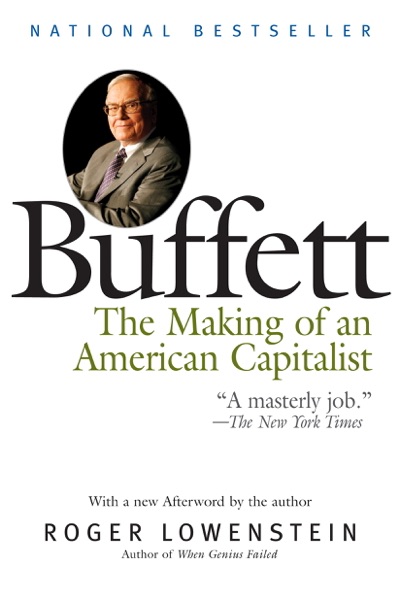
Talk to Buffett: The Making of an American Capitalist like its author wrote you back.
Get the ideas that fit your life — not generic summaries.
- Chat with the book
- Audiobook-style main ideas
- Adapts to your life and goals
- Helps you take action
What it argues
Roger Lowenstein's Buffett is the definitive account of Warren Buffett's life up to the mid-1990s, when his investment record had already made him one of the wealthiest people on earth. Lowenstein, a former Wall Street Journal reporter, spent years interviewing Buffett's family, partners, and colleagues, and the result is a portrait that is more psychologically honest than hagiographic. Buffett the man is shown as driven, sometimes ruthless, emotionally reserved with his family, and almost mystically single-minded about investing from childhood onward.
The book's central argument, never stated as such, is that Buffett's returns are not a mystery — they flow from a small number of principles applied with iron consistency over decades. Buy businesses, not stocks. Pay a fair price for a wonderful company rather than a wonderful price for a fair one. Hold indefinitely. Never sell simply because the price has risen. Avoid businesses you don't understand. These principles, borrowed from Benjamin Graham and refined through Philip Fisher's influence, are simple enough to state in a sentence. What makes Buffett extraordinary, Lowenstein argues, is that he actually applied them when the market, his investors, or his ego might have pushed him toward something more exciting.
What it gets right
- 1.
Buffett's edge is temperamental, not analytical. He buys when others fear and holds when others sell — not as a tactic but as a deeply internalized worldview.
- 2.
A wonderful company at a fair price beats a fair company at a wonderful price. The quality of the underlying business matters more than the entry discount.
- 3.
Circle of competence: Buffett refuses to analyze businesses he can't understand, and this discipline protects him from the fashionable mistakes that ruin most investors.
What it covers
Who wrote it
Roger Lowenstein is an American financial journalist and author who spent a decade as a reporter and columnist for The Wall Street Journal. His other books include When Genius Failed, an account of Long-Term Capital Management's collapse, and The End of Wall Street, covering the 2008 financial crisis. He is known for combining rigorous financial analysis with narrative depth and psychological insight. Buffett, published in 1995, remains widely regarded as the most authoritative biography of Buffett written in the first person's absence.
