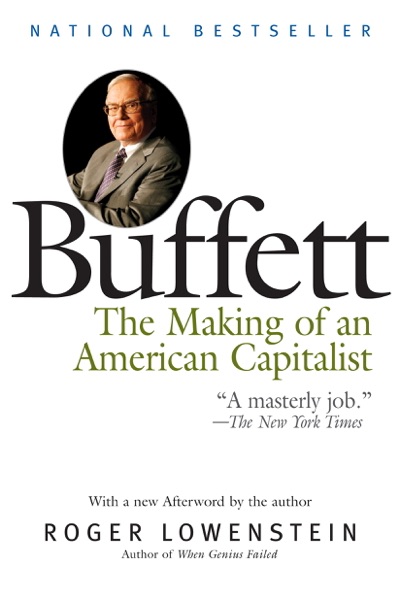
Buffett: The Making of an American Capitalist by Roger Lowenstein is a 1995 biography book about value investing, compounding, character. Buffett's edge is temperamental, not analytical. He buys when others fear and holds when others sell — not as a tactic but as a deeply internalized worldview.
Summary
Roger Lowenstein's Buffett is the definitive account of Warren Buffett's life up to the mid-1990s, when his investment record had already made him one of the wealthiest people on earth. Lowenstein, a former Wall Street Journal reporter, spent years interviewing Buffett's family, partners, and colleagues, and the result is a portrait that is more psychologically honest than hagiographic. Buffett the man is shown as driven, sometimes ruthless, emotionally reserved with his family, and almost mystically single-minded about investing from childhood onward.
The book's central argument, never stated as such, is that Buffett's returns are not a mystery — they flow from a small number of principles applied with iron consistency over decades. Buy businesses, not stocks. Pay a fair price for a wonderful company rather than a wonderful price for a fair one. Hold indefinitely. Never sell simply because the price has risen. Avoid businesses you don't understand. These principles, borrowed from Benjamin Graham and refined through Philip Fisher's influence, are simple enough to state in a sentence. What makes Buffett extraordinary, Lowenstein argues, is that he actually applied them when the market, his investors, or his ego might have pushed him toward something more exciting.
Lowenstein tracks the arc from Buffett's first Omaha partnership in the 1950s through Berkshire Hathaway's transformation from a failing textile mill into a holding company that owns, rather than merely holds, stakes in American icons — GEICO, The Washington Post, Coca-Cola. The mechanics of each investment are covered, but what the book illuminates is the mental model behind each decision: the circle of competence, the margin of safety, the importance of management character, and the arithmetic of compounding.
The book is not a manual and does not read like one. Lowenstein is interested in Buffett as a human being embedded in twentieth-century American life. The chapters on Buffett's marriages, his relationship with Charlie Munger, and the 1991 Salomon Brothers crisis (where Buffett temporarily ran the firm to prevent collapse) are as engaging as any business narrative. Readers who finish it with a cleaner sense of what a genuine long-term investing temperament looks like will have gotten the book's main gift.
Talk to Buffett: The Making of an American Capitalist like its author wrote you back.
Get the ideas that fit your life — not generic summaries.
- Chat with the book
- Audiobook-style main ideas
- Adapts to your life and goals
- Helps you take action
Key takeaways
- 1.
Buffett's edge is temperamental, not analytical. He buys when others fear and holds when others sell — not as a tactic but as a deeply internalized worldview.
- 2.
A wonderful company at a fair price beats a fair company at a wonderful price. The quality of the underlying business matters more than the entry discount.
- 3.
Circle of competence: Buffett refuses to analyze businesses he can't understand, and this discipline protects him from the fashionable mistakes that ruin most investors.
- 4.
Compounding is arithmetic, but most people can't emotionally tolerate its timeline. Buffett's advantage is that he genuinely does not need the money sooner.
- 5.
Management character is a real variable. Buffett pays close attention to how executives behave with shareholder capital, and he avoids managers who enrich themselves at shareholders' expense.
- 6.
The Salomon crisis showed that Buffett's reputation was itself an asset — and that he was willing to spend it down in a genuine emergency while protecting it fiercely at all other times.
- 7.
Buffett's partnership letters and annual reports are a master class in honest communication with investors. He writes about mistakes with the same directness as successes.
- 8.
Patience is not passive. Buffett reads voraciously and thinks continuously, but he acts rarely. The inaction is the output of the process, not a failure to engage.
Discussion questions
Use these on your own, with a book club, or as chat starters in Superbook. Book club version, ready to copy or print →
- 1.
Lowenstein shows that Buffett's investing philosophy is simple but his execution is extraordinary. What makes a simple principle so hard to execute consistently over decades?
- 2.
Buffett's circle of competence kept him out of technology stocks during the dot-com boom and cost him short-term performance. How do you decide what belongs inside your own circle of competence?
- 3.
The book portrays Buffett as emotionally distant from his family while intensely engaged with business. What does that trade-off look like in the lives of people you know?
- 4.
Buffett held Berkshire's stake in The Washington Post for over two decades. What would it mean practically to have that kind of patience in your own work or investments?
- 5.
Charlie Munger broadened Buffett's thinking from buying cheap companies to buying great ones. Who has changed the model of how you think about your field?
- 6.
Lowenstein shows that Buffett's public reputation during the Salomon crisis was both his most valuable asset and his most useful lever. How do you think about your own professional reputation as a long-term asset?
- 7.
Buffett avoided technology stocks not because he thought they were bad businesses but because he couldn't confidently model their future. Where in your own life do you invest in things you don't understand?
- 8.
Lowenstein describes Buffett as essentially the same person at 60 as at 16 — obsessed with numbers, frugal, and intensely competitive. How much of your own professional personality formed early?
- 9.
The partnership letters Buffett wrote to investors in the 1960s are remarkably honest about what he didn't know. Where in your own work are you not being honest enough about uncertainty?
- 10.
Berkshire's model of buying and holding businesses rather than flipping them was unusual in the 1980s LBO era. When have you seen patience outperform activity in your own field?
- 11.
Buffett's long partnership with Munger is central to the story. What is the intellectual partnership in your life that has most changed how you think?
- 12.
The book ends in the mid-1990s. What parts of Buffett's approach, knowing what happened afterward, look even stronger in retrospect, and what looks more limited?
Themes
Frequently asked questions
-
Is Buffett by Roger Lowenstein worth reading?
Yes, particularly if you want to understand why Buffett's returns are not a paradox. The biography's strength is showing the psychological and temperamental roots of his investing philosophy — qualities that are much harder to copy than any specific technique.
-
How is this different from The Snowball by Alice Schroeder?
Lowenstein's book is shorter, more analytically focused, and covers through the mid-1990s. Schroeder's is longer, more personal, and covers Buffett's full life through his 70s. Lowenstein is the better introduction; Schroeder is more comprehensive.
-
Do I need investing knowledge to read this book?
Basic familiarity with stocks and investing helps, but Lowenstein explains the concepts clearly. The book works as a business narrative even for readers with no prior finance background.
-
What is the most important lesson from this biography?
That the investing edge is temperamental. Buffett's principles are public knowledge; almost no one can apply them because doing so requires genuine indifference to short-term pain and social pressure. The biography makes clear how rare that temperament is.
-
How long does Buffett by Lowenstein take to read?
About eight to nine hours at average pace. The narrative moves quickly for a 400-plus-page biography — Lowenstein is a skilled journalist and the chapters are self-contained enough to read in sittings of an hour or less.
Similar books
The Snowball: Warren Buffett and the Business of Life
Alice Schroeder
The Intelligent Investor
Benjamin Graham

Poor Charlie's Almanack
Charlie Munger
The Warren Buffett Way
Robert G. Hagstrom
