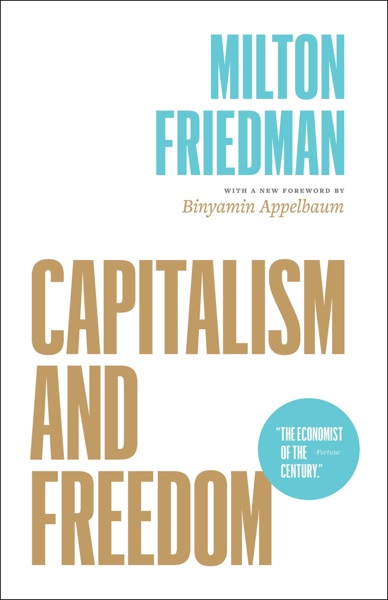
Talk to Capitalism and Freedom like its author wrote you back.
Get the ideas that fit your life — not generic summaries.
- Chat with the book
- Audiobook-style main ideas
- Adapts to your life and goals
- Helps you take action
Capitalism and Freedom, in detail
Capitalism and Freedom was published in 1962, and the ideas it contains had been circulating even longer — the book grew from lectures Friedman gave at a 1956 conference. For much of the decade after its publication it sold modestly, ignored by a mainstream economics profession committed to Keynesian demand management and sympathetic to an active welfare state. Then, as stagflation in the 1970s undermined confidence in those frameworks, the book became one of the foundational texts of the economic liberalism that reshaped policy in the Reagan and Thatcher years.
Friedman's central thesis is that economic and political freedom are deeply connected. A system of competitive capitalism, he argues, promotes political freedom because it separates economic power from political power. When the state controls economic activity, political dissent becomes materially dangerous in a way it does not when jobs, investment, and commerce exist outside government control. This argument draws on Hayek's thinking but Friedman gives it a more empirical and policy-focused treatment.
The book is also a catalogue of policy prescriptions that were heterodox in 1962 and have since become mainstream, contested, or abandoned depending on the domain. Friedman argues for a volunteer military, against occupational licensing, against agricultural price supports, for a flat income tax or negative income tax, for school vouchers, and for floating exchange rates. His chapter on monetary policy, arguing that a rules-based approach would outperform the discretionary management of the Fed, was a direct attack on the prevailing consensus and eventually helped generate the monetarist turn of the late 1970s.
The most persistent criticisms concern what Friedman leaves out. His account of economic freedom says relatively little about concentrated private power — monopoly, monopsony, market dominance — as a threat to freedom comparable to state power. It also largely sets aside questions of starting conditions: voluntary exchange looks very different in a society with reasonably equal starting points than in one with severe structural inequalities. These omissions are worth holding alongside the book's genuine analytical contributions.
The big ideas
- 1.
Competitive capitalism promotes political freedom by dispersing economic power and preventing any single entity — including the state — from controlling all resources.
- 2.
The role of government in a free society should be limited: enforcing contracts, preventing coercion, supplying public goods, and maintaining a stable monetary framework.
- 3.
Monopoly is a problem whether the monopolist is a private firm or the government; Friedman worried most about the latter but acknowledged the former.
