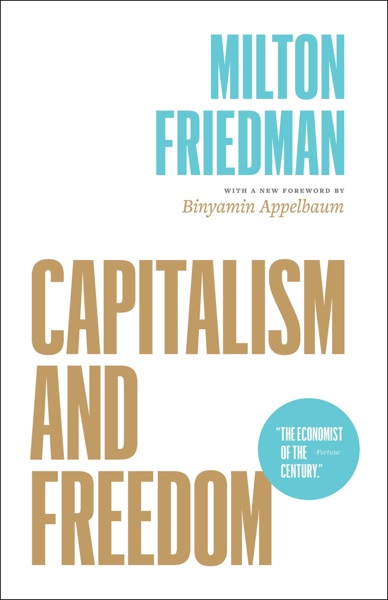
Capitalism and Freedom by Milton Friedman is a 1962 economics book about economic freedom, limited government, monetary policy. Competitive capitalism promotes political freedom by dispersing economic power and preventing any single entity — including the state — from controlling all resources.
Summary
Capitalism and Freedom was published in 1962, and the ideas it contains had been circulating even longer — the book grew from lectures Friedman gave at a 1956 conference. For much of the decade after its publication it sold modestly, ignored by a mainstream economics profession committed to Keynesian demand management and sympathetic to an active welfare state. Then, as stagflation in the 1970s undermined confidence in those frameworks, the book became one of the foundational texts of the economic liberalism that reshaped policy in the Reagan and Thatcher years.
Friedman's central thesis is that economic and political freedom are deeply connected. A system of competitive capitalism, he argues, promotes political freedom because it separates economic power from political power. When the state controls economic activity, political dissent becomes materially dangerous in a way it does not when jobs, investment, and commerce exist outside government control. This argument draws on Hayek's thinking but Friedman gives it a more empirical and policy-focused treatment.
The book is also a catalogue of policy prescriptions that were heterodox in 1962 and have since become mainstream, contested, or abandoned depending on the domain. Friedman argues for a volunteer military, against occupational licensing, against agricultural price supports, for a flat income tax or negative income tax, for school vouchers, and for floating exchange rates. His chapter on monetary policy, arguing that a rules-based approach would outperform the discretionary management of the Fed, was a direct attack on the prevailing consensus and eventually helped generate the monetarist turn of the late 1970s.
The most persistent criticisms concern what Friedman leaves out. His account of economic freedom says relatively little about concentrated private power — monopoly, monopsony, market dominance — as a threat to freedom comparable to state power. It also largely sets aside questions of starting conditions: voluntary exchange looks very different in a society with reasonably equal starting points than in one with severe structural inequalities. These omissions are worth holding alongside the book's genuine analytical contributions.
Talk to Capitalism and Freedom like its author wrote you back.
Get the ideas that fit your life — not generic summaries.
- Chat with the book
- Audiobook-style main ideas
- Adapts to your life and goals
- Helps you take action
Key takeaways
- 1.
Competitive capitalism promotes political freedom by dispersing economic power and preventing any single entity — including the state — from controlling all resources.
- 2.
The role of government in a free society should be limited: enforcing contracts, preventing coercion, supplying public goods, and maintaining a stable monetary framework.
- 3.
Monopoly is a problem whether the monopolist is a private firm or the government; Friedman worried most about the latter but acknowledged the former.
- 4.
Occupational licensing frequently protects incumbents from competition rather than protecting the public — a pattern across medicine, law, and dozens of other fields.
- 5.
A negative income tax would provide a guaranteed income floor more efficiently than categorical welfare programs, avoiding the poverty traps those programs create.
- 6.
School vouchers would improve education quality by introducing competition; parents would move children to better schools, forcing poor schools to improve or close.
- 7.
Monetary policy governed by fixed rules would outperform discretionary management by central banks, which historically amplified rather than dampened economic cycles.
- 8.
The concentration of power in the state is more dangerous than concentration in the market because the state holds a monopoly on coercive force.
Discussion questions
Use these on your own, with a book club, or as chat starters in Superbook. Book club version, ready to copy or print →
- 1.
Friedman argues competitive markets separate economic from political power. Is that separation stable, or does economic concentration eventually translate into political influence?
- 2.
The book largely sets aside the question of starting conditions. How much does economic freedom matter if people begin with very unequal endowments of capital, education, and social connections?
- 3.
Which of Friedman's 1962 policy proposals have been implemented? Which look prescient, and which have proved more complicated than he suggested?
- 4.
Friedman is sceptical of occupational licensing. Are there cases where you think licensing genuinely protects the public, or does the evidence support his critique uniformly?
- 5.
How does the negative income tax proposal compare to universal basic income proposals now circulating? What is similar and what is different?
- 6.
The school voucher argument rests on competitive pressure improving quality. Where has competition in education produced better outcomes, and where hasn't it?
- 7.
Friedman distrusted discretionary monetary policy. How do you evaluate that position after the 2008 crisis, when discretionary central bank action arguably prevented a depression?
- 8.
The book was written at the height of Cold War anxiety about state power. How does reading it in 2025 change which anxieties feel most relevant?
- 9.
Friedman acknowledges market failure but argues government failure is typically worse. Is that a principled position or a rhetorical move?
- 10.
Many of Friedman's ideas entered mainstream policy. Has that vindicated him, or have the limits of those policies become more visible in practice?
- 11.
The book argues military conscription is an infringement of freedom. How do you weigh freedom from conscription against the equity arguments for shared military obligation?
- 12.
Friedman's framework largely ignores environmental externalities. How would a strict Friedmanite address climate change, and is that answer adequate?
Themes
Frequently asked questions
-
What is Capitalism and Freedom about?
It is Friedman's argument that economic freedom — the freedom to own property, enter contracts, and engage in voluntary exchange — is both intrinsically valuable and essential to political freedom. The book pairs that philosophical argument with specific policy proposals across taxation, education, monetary policy, and social regulation.
-
How influential has Capitalism and Freedom been?
Very. It was largely ignored when published in 1962 but became a foundational text for economic conservatives after Keynesian consensus broke down in the 1970s. Its policy proposals — floating exchange rates, school vouchers, the negative income tax, ending conscription — influenced governments from the 1980s onward.
-
Is Capitalism and Freedom hard to read?
No. Friedman wrote for an intelligent general reader, not for academic economists. The arguments are clear and the policy chapters are relatively self-contained, though some of the monetary policy discussion assumes basic familiarity with macroeconomics.
-
What is the main criticism of the book?
That it largely ignores the threat to freedom from concentrated private power, treats market starting conditions as irrelevant to freedom, and underestimates market failures in areas like environmental externalities and financial instability.
-
How does this compare to Hayek's The Road to Serfdom?
Both make the connection between economic and political freedom, but Hayek's book is more philosophical and historically focused on the trajectory toward totalitarianism. Friedman's book is more policy-specific and empirical, and more optimistic about the practical program of economic liberalism.
Similar books
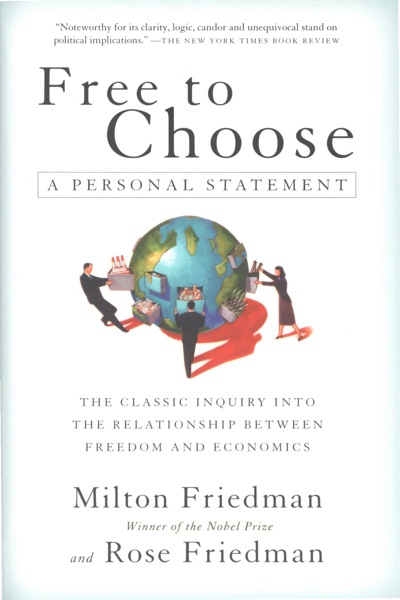
Free to Choose: A Personal Statement
Milton Friedman and Rose Friedman
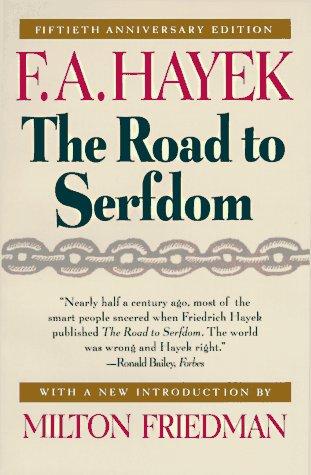
The Road to Serfdom
F. A. Hayek
Why Nations Fail: The Origins of Power, Prosperity, and Poverty
Daron Acemoglu and James A. Robinson
The Wealth of Nations
Adam Smith
