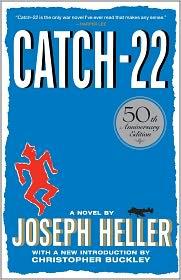
Talk to Catch-22 like its author wrote you back.
Get the ideas that fit your life — not generic summaries.
- Chat with the book
- Audiobook-style main ideas
- Adapts to your life and goals
- Helps you take action
What it argues
Yossarian is a bombardier stationed on the Mediterranean island of Pianosa during World War II who has concluded that the people trying to kill him are not the enemy — they're everyone, including his own commanders. He wants to be declared insane so he can go home. But there's a catch: wanting to avoid combat is a sign of sanity, which means anyone who asks to be grounded is sane enough to fly. Catch-22. Published in 1961 after years of rejection, Joseph Heller's novel invented a new way of writing about war — not as tragedy or heroism but as pure institutional comedy that accumulates into something devastating.
The novel has almost no linear plot. It circles and loops, returning to the same events from different angles, introducing characters who are brilliant comic inventions (the mess officer Milo Minderbinder, who contracts the German Air Force to bomb his own squadron because it pencils out; the general who evaluates his officers by how well they pose for photographs) and then suddenly, without warning, letting you see what war does to a body. The tonal shifts are the point. Heller understood that gallows humor and real horror aren't opposites — they coexist, and the comedy makes the violence more unbearable when it arrives.
What it gets right
- 1.
The novel's central insight is that institutional logic and human survival are fundamentally incompatible. The military exists to use bodies; Yossarian exists to keep his. Neither position is irrational on its own terms.
- 2.
Milo Minderbinder's capitalism is the novel's darkest joke: the market mechanism is so powerful that it eventually contracts with the enemy to bomb its own side, and is forgiven because it turns a profit.
- 3.
The Catch-22 paradox extends beyond flying. Every system of rules produces a meta-rule that protects the system from anyone who sees through it clearly enough to object.
What it covers
Who wrote it
Joseph Heller (1923–1999) flew sixty combat missions as a bombardier in World War II before becoming an advertising copywriter in New York. Catch-22 took eight years to write and was rejected by several major publishers before Scribner's published it in 1961. It sold modestly at first and then became one of the defining novels of the Vietnam era, with sales accelerating as the war grew more controversial. Heller published five subsequent novels, including Something Happened (1974) and Good as Gold (1979), none of which approached Catch-22's reach. He remained in New York until his death.
