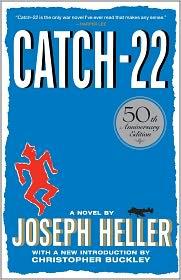
Catch-22 by Joseph Heller is a 1961 literary fiction book about war and absurdity, institutional logic versus survival, sanity and madness. The novel's central insight is that institutional logic and human survival are fundamentally incompatible. The military exists to use bodies; Yossarian exists to keep his. Neither position is irrational on its own terms.
Summary
Yossarian is a bombardier stationed on the Mediterranean island of Pianosa during World War II who has concluded that the people trying to kill him are not the enemy — they're everyone, including his own commanders. He wants to be declared insane so he can go home. But there's a catch: wanting to avoid combat is a sign of sanity, which means anyone who asks to be grounded is sane enough to fly. Catch-22. Published in 1961 after years of rejection, Joseph Heller's novel invented a new way of writing about war — not as tragedy or heroism but as pure institutional comedy that accumulates into something devastating.
The novel has almost no linear plot. It circles and loops, returning to the same events from different angles, introducing characters who are brilliant comic inventions (the mess officer Milo Minderbinder, who contracts the German Air Force to bomb his own squadron because it pencils out; the general who evaluates his officers by how well they pose for photographs) and then suddenly, without warning, letting you see what war does to a body. The tonal shifts are the point. Heller understood that gallows humor and real horror aren't opposites — they coexist, and the comedy makes the violence more unbearable when it arrives.
The bureaucratic logic of the military is treated as a closed system that operates entirely independent of the war it's supposed to be fighting. Officers seek promotion. Clerks protect their paperwork. Milo's M&M Enterprises buys and sells everything, including human lives. The system isn't evil; it's indifferent to human bodies in a way that produces evil without anyone intending it. Yossarian's radicalism is just his desire to stay alive, which the institution treats as a disciplinary problem.
Catch-22 is funny in a way that requires some acclimation — the jokes are repetitive, the characters exaggerated, and the chronology deliberately fractured. Readers who need a novel to move forward or build toward something may find the first hundred pages disorienting. But once the logic clicks, it's one of the most rereading-worthy novels in English: you keep finding jokes that have death inside them. The last fifty pages are among the most affecting in American literature, precisely because Heller earned them through 450 pages of comedy.
Talk to Catch-22 like its author wrote you back.
Get the ideas that fit your life — not generic summaries.
- Chat with the book
- Audiobook-style main ideas
- Adapts to your life and goals
- Helps you take action
Key takeaways
- 1.
The novel's central insight is that institutional logic and human survival are fundamentally incompatible. The military exists to use bodies; Yossarian exists to keep his. Neither position is irrational on its own terms.
- 2.
Milo Minderbinder's capitalism is the novel's darkest joke: the market mechanism is so powerful that it eventually contracts with the enemy to bomb its own side, and is forgiven because it turns a profit.
- 3.
The Catch-22 paradox extends beyond flying. Every system of rules produces a meta-rule that protects the system from anyone who sees through it clearly enough to object.
- 4.
The novel's nonlinear structure isn't an experiment — it's how trauma memory works. The same event recurs with new context each time, and what seems funny in one version is horrifying in another.
- 5.
Doc Daneeka legally dies when his name appears on a crashed flight manifest, even though he's standing right there. Heller's point: paper reality outranks physical reality in bureaucratic systems.
- 6.
Snowden's death, glimpsed in fragments throughout, becomes the novel's emotional center when finally revealed in full. Everything Yossarian knows about the body and war is in that scene.
- 7.
The women in the novel are mostly absent or objectified — a real limitation. Heller was writing a soldiers' world and largely reproduced its blind spots.
- 8.
The ending — Yossarian's decision to desert and row to Sweden — is read as both heroic and absurd. The novel allows it to be both.
Discussion questions
Use these on your own, with a book club, or as chat starters in Superbook. Book club version, ready to copy or print →
- 1.
Yossarian's position is simple: he just wants to survive. The institution treats this as insubordination. Is his individualism heroic, selfish, or just sane?
- 2.
Milo Minderbinder bombs his own squadron and is forgiven because it pencils out financially. Is this satire of capitalism, or is Heller saying something darker about how economies relate to war?
- 3.
The novel's humor gets progressively harder to laugh at as the body count rises. Did you notice where you stopped laughing? What changed?
- 4.
The Catch-22 trap — you can't escape a system by using the system's logic — applies outside the military. Where have you encountered it?
- 5.
Doc Daneeka continues to live while officially dead. Major Major Major Major can only be seen when he's not in his office. What is Heller doing with identity and institutional record?
- 6.
The officers — Cathcart, Dreedle, Peckem — are entirely motivated by careerism and compete with each other in ways that have nothing to do with the war. Is this exaggeration, or does it ring true?
- 7.
Snowden's death is revealed slowly across the novel. How does Heller's withholding of the full scene affect your experience of reading the book up to that point?
- 8.
Nately's whore pursues Yossarian throughout the second half of the novel for reasons that are never explained. What does she represent, and why does she keep trying to kill him?
- 9.
Is Yossarian a hero? He does almost nothing brave, and his final act is desertion. Does the novel endorse him, or just understand him?
- 10.
Heller was a World War II veteran writing in 1961 about the Korean War as much as the Second World War. Does the novel feel specific to a historical moment, or does its logic apply to all wars?
- 11.
Orr's escape at the end retroactively reframes his apparent incompetence. Did you read any of the earlier Orr scenes as hints? What does Heller want you to think about how we read competence?
- 12.
The novel was rejected by many publishers. Today it's often ranked among the greatest American novels. What about it still makes publishers nervous — or readers resistant?
Themes
Frequently asked questions
-
Is Catch-22 hard to read?
The first hundred pages are disorienting because the novel doesn't move chronologically and introduces dozens of characters without clear context. Readers who push past that find the logic clicks into place. The language itself is not difficult — Heller's prose is clear and the jokes are usually obvious.
-
What is the Catch-22 paradox?
The original: to be grounded as insane, a pilot must request it; but requesting it proves you're sane enough to fly. More broadly in the novel: any rule that appears to offer an escape contains a clause that closes the escape. The phrase has entered the language to mean any self-defeating circular trap.
-
Is Catch-22 anti-war?
Yes, but not simply. Heller doesn't argue that all wars are wrong — the novel is set in the war against Nazi Germany, which most characters accept as worth fighting. He argues that the institutional apparatus around war operates independently of the war's purpose and produces its own atrocities.
-
How long is Catch-22 and how long does it take to read?
The novel is roughly 175,000 words — just under 500 pages in most editions. At 250 words per minute it takes about twelve hours. It reads faster in the comic sections and slower as it gets darker.
-
Who shouldn't read Catch-22?
Readers who need linear plot, sympathetic romantic leads, or military stories told with dignity will find it irritating. The novel is deliberately repetitive, structurally fractured, and treats almost everything as a joke before revealing what the joke is hiding.