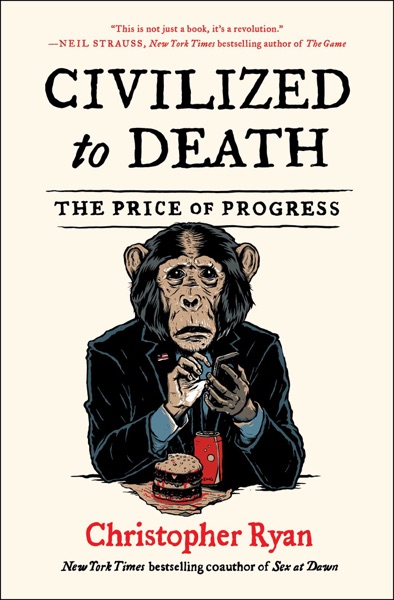
Talk to Civilized to Death like its author wrote you back.
Get the ideas that fit your life — not generic summaries.
- Chat with the book
- Audiobook-style main ideas
- Adapts to your life and goals
- Helps you take action
Civilized to Death, in detail
Christopher Ryan is the co-author of Sex at Dawn, a 2010 book that argued human beings are not naturally monogamous. Civilized to Death extends that project into a broader critique: the claim that civilization, understood as the complex of agriculture, hierarchy, sedentary settlement, and accumulation that has been the dominant form of human life for ten thousand years, has made people measurably unhappier and unhealthier than the forager existence it replaced.
Ryan's argument proceeds on two tracks. The first is anthropological and historical. Forager societies, the evidence suggests, had shorter average lifespans dominated by childhood mortality but long adult lifespans once you survived infancy; had diets that were diverse, nutritionally complete, and obtained in far fewer working hours than farming requires; lacked the chronic diseases — diabetes, obesity, cardiovascular disease — that characterize modern populations; and had social structures that were more egalitarian, more cooperative, and less violent than agricultural and industrial societies. Ryan is careful to distinguish "nasty, brutish, and short" mythology from what the actual evidence shows.
The second track is more personal and rhetorical. Ryan argues that the psychological costs of civilization — chronic stress, alienation, loneliness, anxiety, depression — are not natural features of the human condition but adaptations to a way of life that our evolved psychology is poorly fitted for. He cites rates of depression, loneliness, and suicide that have increased alongside prosperity, the epidemic of meaningless work, and the collapse of the kinds of close community that forager bands provided. He is not arguing for a return to foraging, which is impossible, but for a re-examination of which features of modern life we accept as inevitable or necessary.
The book is at its best when it is reporting evidence. The sections on forager health and diet, on the evidence for preindustrial violence rates, and on the physical costs of agriculture are genuinely interesting and well-sourced. Ryan is less persuasive when he argues by implication that because things were different they were better. His nostalgia for a past that never actually existed in pure form — no forager society was untouched by trade, disease, or conflict with neighbors — is the book's recurring weakness. But as a provocation to reconsider which aspects of modern life are actually good for human beings, it is effective.
The big ideas
- 1.
Agriculture required substantially more work than foraging for a less nutritionally complete diet and greater vulnerability to famines from crop failure.
- 2.
Forager adults who survived childhood typically lived long lives — rates of degenerative disease, not violent death, distinguish modern from forager populations most sharply.
- 3.
Chronic diseases — type 2 diabetes, cardiovascular disease, obesity — are diseases of civilization, essentially absent from populations that don't eat processed carbohydrates and refined foods.
