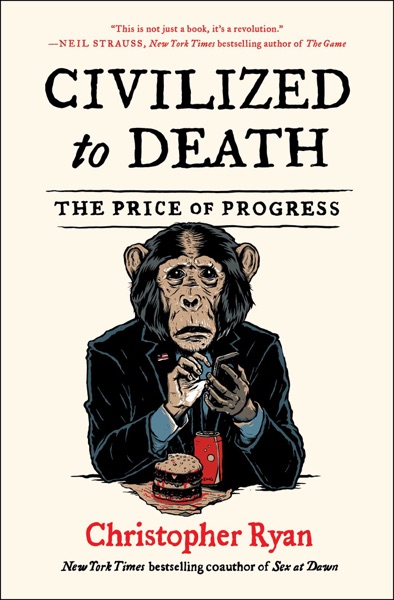
Civilized to Death by Christopher Ryan is a 2019 science book about civilization, human nature, hunter-gatherers. Agriculture required substantially more work than foraging for a less nutritionally complete diet and greater vulnerability to famines from crop failure.
Summary
Christopher Ryan is the co-author of Sex at Dawn, a 2010 book that argued human beings are not naturally monogamous. Civilized to Death extends that project into a broader critique: the claim that civilization, understood as the complex of agriculture, hierarchy, sedentary settlement, and accumulation that has been the dominant form of human life for ten thousand years, has made people measurably unhappier and unhealthier than the forager existence it replaced.
Ryan's argument proceeds on two tracks. The first is anthropological and historical. Forager societies, the evidence suggests, had shorter average lifespans dominated by childhood mortality but long adult lifespans once you survived infancy; had diets that were diverse, nutritionally complete, and obtained in far fewer working hours than farming requires; lacked the chronic diseases — diabetes, obesity, cardiovascular disease — that characterize modern populations; and had social structures that were more egalitarian, more cooperative, and less violent than agricultural and industrial societies. Ryan is careful to distinguish "nasty, brutish, and short" mythology from what the actual evidence shows.
The second track is more personal and rhetorical. Ryan argues that the psychological costs of civilization — chronic stress, alienation, loneliness, anxiety, depression — are not natural features of the human condition but adaptations to a way of life that our evolved psychology is poorly fitted for. He cites rates of depression, loneliness, and suicide that have increased alongside prosperity, the epidemic of meaningless work, and the collapse of the kinds of close community that forager bands provided. He is not arguing for a return to foraging, which is impossible, but for a re-examination of which features of modern life we accept as inevitable or necessary.
The book is at its best when it is reporting evidence. The sections on forager health and diet, on the evidence for preindustrial violence rates, and on the physical costs of agriculture are genuinely interesting and well-sourced. Ryan is less persuasive when he argues by implication that because things were different they were better. His nostalgia for a past that never actually existed in pure form — no forager society was untouched by trade, disease, or conflict with neighbors — is the book's recurring weakness. But as a provocation to reconsider which aspects of modern life are actually good for human beings, it is effective.
Talk to Civilized to Death like its author wrote you back.
Get the ideas that fit your life — not generic summaries.
- Chat with the book
- Audiobook-style main ideas
- Adapts to your life and goals
- Helps you take action
Key takeaways
- 1.
Agriculture required substantially more work than foraging for a less nutritionally complete diet and greater vulnerability to famines from crop failure.
- 2.
Forager adults who survived childhood typically lived long lives — rates of degenerative disease, not violent death, distinguish modern from forager populations most sharply.
- 3.
Chronic diseases — type 2 diabetes, cardiovascular disease, obesity — are diseases of civilization, essentially absent from populations that don't eat processed carbohydrates and refined foods.
- 4.
Depression, loneliness, and anxiety have increased in wealthy societies alongside material prosperity, suggesting that the causes are social and structural rather than material.
- 5.
Small-group living, the default for most of human evolutionary history, provided the social density and mutual accountability that large modern societies structurally cannot.
- 6.
Progress narratives about civilization assume that longer life expectancy, lower violence rates, and greater material wealth are unambiguous goods — Ryan argues the tradeoffs are more complex.
- 7.
Meaningful work — work that has visible results, is done for people you know, and connects to genuine need — is rare in modern labor markets and its absence is costly.
- 8.
The idea that life before civilization was primarily miserable is a post-hoc justification for the enormous sacrifices that agriculture and industrialization demanded.
Discussion questions
Use these on your own, with a book club, or as chat starters in Superbook. Book club version, ready to copy or print →
- 1.
Ryan argues that civilization's gains — longer average lifespans, lower violence, greater material wealth — come with real costs that the progress narrative obscures. Which costs do you find most compelling, and which do you find exaggerated?
- 2.
The book claims that forager work lives were shorter and more satisfying than agricultural ones. What does your own relationship with work tell you about this claim?
- 3.
He argues that depression and anxiety are not natural features of human psychology but adaptations to a misfit between our evolved needs and modern conditions. Does that explanation fit your own experience?
- 4.
Ryan distinguishes between lifespans distorted by child mortality and the actual longevity of adults who survived childhood. How does that distinction change your understanding of what 'life expectancy' means?
- 5.
The absence of chronic diseases in forager populations is well-documented. What would it actually require to change modern diets and environments enough to see comparable results?
- 6.
He suggests that the close community of small bands provided something modern social structures cannot. What do you currently have that comes closest to that kind of social density?
- 7.
Ryan admits a return to foraging is impossible but wants to salvage lessons from forager life. Which lessons seem most transferable to your actual circumstances?
- 8.
The book is explicitly a provocation rather than a policy proposal. What is the most useful provocation it raises for how you think about your own life choices?
- 9.
He is critical of progress narratives that treat the direction of change as inherently good. What narrative about progress do you find yourself most uncritically accepting?
- 10.
Sex at Dawn argued that monogamy is not natural for humans. Civilized to Death makes a parallel argument about many civilization's other structures. Where do you find the argument compelling and where does it seem to overreach?
- 11.
The communities of meaning Ryan describes — shared work, known neighbors, mutual obligation — are absent from most modern urban lives. What is your actual community of mutual obligation?
- 12.
If you could change one feature of modern life that Ryan identifies as costly, what would it be, and what would you be willing to give up to get it?
Themes
Frequently asked questions
-
Is Civilized to Death anti-science or anti-progress?
Not exactly. Ryan cites anthropological and epidemiological evidence extensively. His argument is not that science is wrong or that improvement is impossible, but that the dominant progress narrative ignores evidence about what has been lost. He's critiquing the story we tell, not the methods used to study it.
-
How does this compare to Sex at Dawn?
Civilized to Death is more ambitious in scope — it's not just about sexuality but about agriculture, work, disease, and social structure — and less focused as a result. Sex at Dawn has a clearer thesis and marshals evidence more systematically. If you found Sex at Dawn compelling, Civilized to Death is a worthwhile extension.
-
Is Ryan arguing we should all become hunter-gatherers?
He's explicit that he isn't. The book is a provocation: to identify which features of modern life we accept as inevitable or natural that are actually choices, and which of those choices we might make differently. The practical prescriptions are individual and modest.
-
What's the strongest part of the book?
The sections on forager health and diet, particularly the epidemiological evidence on the absence of chronic diseases in populations that haven't adopted industrial food systems. These parts are well-sourced and genuinely illuminating.
-
What's the book's biggest weakness?
Ryan's tendency to romanticize forager life and to treat complexity and ambiguity as if they always resolved in the direction of his thesis. He is more credible as a critic of progress mythology than as a guide to what would actually make human lives better.