Science · Book club
Climbing Mount Improbable book club questions
Here are 12 book club questions for Climbing Mount Improbable by Richard Dawkins, ordered to open easily and end somewhere worth arguing about. Copy them, print them, or bring them up one at a time.
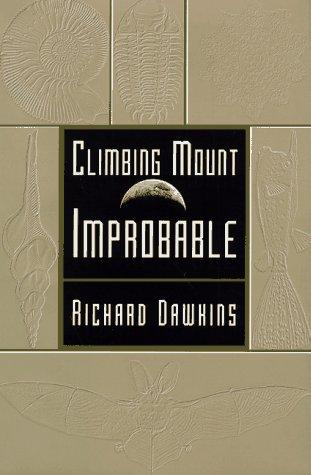
Climbing Mount Improbable is Richard Dawkins's response to the persistent intuition that complex biological structures — the vertebrate eye, insect wings, spider webs — are too improbable to have evolved by chance.
Richard Dawkins · 1996 · 6h 0m
Full summary and key takeaways →The 12 questions
- 1.
The 'sheer cliff' version of Mount Improbable imagines complex structures arriving all at once. Where else in everyday reasoning do we make the same mistake of ignoring incremental paths?
- 2.
Dawkins shows the eye has evolved independently dozens of times. Does the convergence of similar solutions under similar selection pressures feel like evidence for something about physics and biology, or just about selection?
- 3.
The arms race metaphor describes escalating complexity driven by conflict. Can you think of examples in human society — technological, economic, social — that follow the same logic?
- 4.
Cumulative selection means each step is selected for a reason. Does that make the end product feel less contingent, or does the unpredictability of mutations still make the outcome feel historical and arbitrary?
- 5.
The fig-wasp relationship is so intricate it was used as an argument for design before it was understood evolutionarily. What makes something look designed rather than evolved, and is that distinction always reliable?
- 6.
Dawkins argues that every intermediate form in the evolution of the eye was functional. Is that a falsifiable claim? What would a non-functional intermediate form imply?
- 7.
The book explains complexity without invoking a designer. Does the explanation feel complete, or does the origin of the selection process itself remain unexplained?
- 8.
Which case study in the book did you find most persuasive as an argument for cumulative selection? Which felt least satisfying?
- 9.
Natural selection has no foresight — it selects for current advantage regardless of future consequences. Does that limitation ever produce outcomes that look poorly engineered in hindsight?
- 10.
Dawkins is patient and non-combative in this book compared to his later work. Does the tone change how persuasive you find the argument?
- 11.
Spider web architecture has been studied by engineers for structural insights. What does it mean for nature to have 'solved' engineering problems before engineers did?
- 12.
The mountain metaphor implies there is always a gradual path to any complex adaptation. Is there any adaptation that genuinely challenges that assumption?
How to run the discussion
- Pick six to eight, not all of them. An hour of real discussion covers fewer questions than anyone expects, and racing the list is what makes a book club feel like homework.
- Open with what people noticed, not what they concluded. Asking for a verdict first hardens opinions before anyone has heard each other.
- Let the disagreement run. The questions below that split a room are the ones worth the time; the ones everyone answers the same way can be skipped.
- Ask the quiet person a specific question. A direct, narrow question is far easier to answer than an open invitation to contribute.
Themes worth steering toward
If the conversation stalls, these are the threads that usually restart it.
Common questions
What are good book club questions for Climbing Mount Improbable?
Here are 12 book club questions for Climbing Mount Improbable by Richard Dawkins, ordered to open easily and end somewhere worth arguing about. The strongest openers ask what each reader noticed rather than what they concluded, and the discussion usually turns on evolution, natural selection, complexity.
How long should a book club discussion of Climbing Mount Improbable last?
Most groups run 60 to 90 minutes of actual discussion. That is roughly six to eight questions, not all of them, so pick the ones that suit your group rather than working down the list in order.
What are the main themes in Climbing Mount Improbable?
Evolution, Natural selection, Complexity, Adaptation, Biology. Those are the threads most likely to divide a room, which makes them the useful places to steer a discussion that has gone quiet.
Picking the next one? See books like Climbing Mount Improbable or questions for other book club picks.
