Science · Book club
Code: The Hidden Language of Computer Hardware and Software book club questions
Here are 11 book club questions for Code: The Hidden Language of Computer Hardware and Software by Charles Petzold, ordered to open easily and end somewhere worth arguing about. Copy them, print them, or bring them up one at a time.
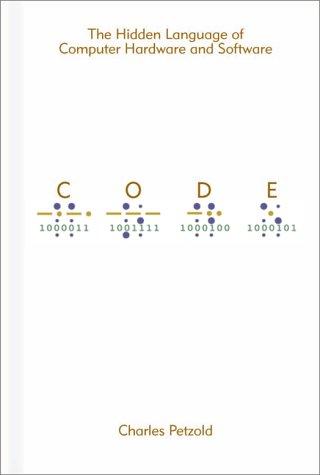
Code is Charles Petzold's explanation of how computers work, built from first principles.
Charles Petzold · 1999 · 8h 45m
Full summary and key takeaways →The 11 questions
- 1.
Did building up a computer from relays and logic gates change how you think about what your computer or phone is actually doing when you use it?
- 2.
The book shows that Boolean algebra — a pure mathematics invented in the 1850s — perfectly describes electronic circuits. What does that coincidence tell you about mathematics and the physical world?
- 3.
Petzold builds the entire computer from two-state switches. Does knowing that all computation reduces to ones and zeros change how you think about information?
- 4.
The historical narrative — Morse code, Braille, Victorian engineers — connects the modern computer to a long lineage of communication technologies. Which historical link surprised you most?
- 5.
Machine code is binary sequences a processor executes directly. Does understanding that level of abstraction make you more or less confident in software?
- 6.
Floating-point arithmetic approximates real numbers and introduces specific errors. Were you aware of that limitation before, and does it concern you in practical applications?
- 7.
An operating system abstracts the hardware so applications don't need to know about specific hardware. What other examples of beneficial abstraction can you think of in technology or daily life?
- 8.
Petzold builds up to a processor without introducing the internet or software at all. What does that scope choice tell you about where the complexity actually lives?
- 9.
The book was written in 1999 and predates smartphones. Which concepts it explains are most central to understanding mobile computing specifically?
- 10.
Code assumes no prior technical knowledge. Is that the right choice for a book about hardware, or does it mean the final chapters are too compressed?
- 11.
Who do you think would benefit most from reading this book, and how would understanding it change how they work?
How to run the discussion
- Pick six to eight, not all of them. An hour of real discussion covers fewer questions than anyone expects, and racing the list is what makes a book club feel like homework.
- Open with what people noticed, not what they concluded. Asking for a verdict first hardens opinions before anyone has heard each other.
- Let the disagreement run. The questions below that split a room are the ones worth the time; the ones everyone answers the same way can be skipped.
- Ask the quiet person a specific question. A direct, narrow question is far easier to answer than an open invitation to contribute.
Themes worth steering toward
If the conversation stalls, these are the threads that usually restart it.
Common questions
What are good book club questions for Code: The Hidden Language of Computer Hardware and Software?
Here are 11 book club questions for Code: The Hidden Language of Computer Hardware and Software by Charles Petzold, ordered to open easily and end somewhere worth arguing about. The strongest openers ask what each reader noticed rather than what they concluded, and the discussion usually turns on computing, binary code, hardware.
How long should a book club discussion of Code: The Hidden Language of Computer Hardware and Software last?
Most groups run 60 to 90 minutes of actual discussion. That is roughly six to eight questions, not all of them, so pick the ones that suit your group rather than working down the list in order.
What are the main themes in Code: The Hidden Language of Computer Hardware and Software?
Computing, Binary code, Hardware, Programming, Technology. Those are the threads most likely to divide a room, which makes them the useful places to steer a discussion that has gone quiet.
Picking the next one? See books like Code: The Hidden Language of Computer Hardware and Software or questions for other book club picks.
