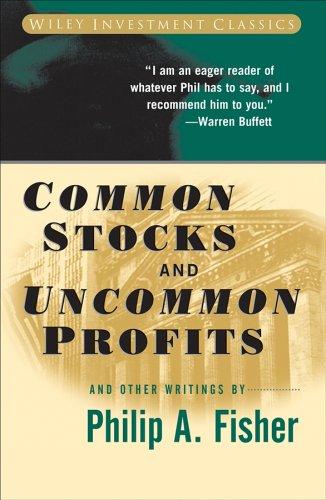
Talk to Common Stocks and Uncommon Profits like its author wrote you back.
Get the ideas that fit your life — not generic summaries.
- Chat with the book
- Audiobook-style main ideas
- Adapts to your life and goals
- Helps you take action
What it argues
Common Stocks and Uncommon Profits is Philip Fisher's argument that the best investment returns come from identifying great companies — those with strong management, excellent products, and durable competitive positions — and holding them for very long periods. Published in 1958 and still in print, it was one of the first investing books to focus on the qualitative characteristics of businesses rather than purely on price and balance sheet metrics, and it profoundly influenced Warren Buffett, who described his investment approach as roughly "85 percent Graham, 15 percent Fisher."
Fisher's most famous contribution is the "scuttlebutt" method of investment research. Rather than relying solely on public filings and financial statements, Fisher recommended talking to a company's competitors, suppliers, customers, employees, and former employees to build a picture of its competitive position and management quality from multiple angles. This approach treats investing as a form of investigative journalism — the goal is to understand the business more deeply than any single source can reveal.
What it gets right
- 1.
The best returns come from identifying companies with genuine long-term growth prospects and holding them for years or decades, not from trading or value mean-reversion.
- 2.
Scuttlebutt research — talking to competitors, suppliers, customers, and employees — reveals the true competitive position of a company in ways that financial filings cannot.
- 3.
Management quality is the central variable in long-term business performance. Great products and markets cannot compensate for poor management over long enough time horizons.
What it covers
Who wrote it
Philip A. Fisher (1907–2004) was an American investment manager and author who founded Fisher and Company in San Francisco in 1931 and ran it for over seven decades. His investment approach focused on growth companies with excellent management and long-term holding periods, in contrast to the value-focused, balance-sheet-oriented approach dominant in his era. In addition to Common Stocks and Uncommon Profits, he wrote Paths to Wealth Through Common Stocks and Conservative Investors Sleep Well. His work directly influenced Warren Buffett, who has cited Fisher alongside Benjamin Graham as a primary intellectual influence on his investment philosophy. Fisher was known for…
