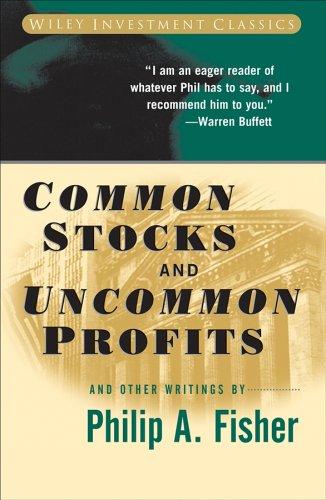
Talk to Common Stocks and Uncommon Profits like its author wrote you back.
Get the ideas that fit your life — not generic summaries.
- Chat with the book
- Audiobook-style main ideas
- Adapts to your life and goals
- Helps you take action
Common Stocks and Uncommon Profits, in detail
Common Stocks and Uncommon Profits is Philip Fisher's argument that the best investment returns come from identifying great companies — those with strong management, excellent products, and durable competitive positions — and holding them for very long periods. Published in 1958 and still in print, it was one of the first investing books to focus on the qualitative characteristics of businesses rather than purely on price and balance sheet metrics, and it profoundly influenced Warren Buffett, who described his investment approach as roughly "85 percent Graham, 15 percent Fisher."
Fisher's most famous contribution is the "scuttlebutt" method of investment research. Rather than relying solely on public filings and financial statements, Fisher recommended talking to a company's competitors, suppliers, customers, employees, and former employees to build a picture of its competitive position and management quality from multiple angles. This approach treats investing as a form of investigative journalism — the goal is to understand the business more deeply than any single source can reveal.
The "fifteen points" framework is the book's analytical core. Fisher identifies fifteen qualities he looks for in a stock: significant sales growth potential, management commitment to developing new products, how effective the company's research and development organization is, whether the company has an above-average sales organization, good profit margins and the effort to maintain them, what the company does to maintain or improve margins, how good the company's labor and personnel relations are, the quality of executive relations, depth of management, how good the company's cost and accounting controls are, other aspects specific to the business, a long-term profit outlook, growth without diluting equity, management transparency with investors, and an unquestionable management integrity.
The book is deliberately conservative about when to sell — Fisher argues that the time to sell a great company is almost never, unless you made a mistake in the original assessment, the company's fundamental character has changed, or you find an unambiguously better opportunity. This long-term orientation is at odds with most trading behavior and reflects Fisher's conviction that the greatest investment returns come from concentration in great companies held through all the volatility that comes with time.
The big ideas
- 1.
The best returns come from identifying companies with genuine long-term growth prospects and holding them for years or decades, not from trading or value mean-reversion.
- 2.
Scuttlebutt research — talking to competitors, suppliers, customers, and employees — reveals the true competitive position of a company in ways that financial filings cannot.
- 3.
Management quality is the central variable in long-term business performance. Great products and markets cannot compensate for poor management over long enough time horizons.
