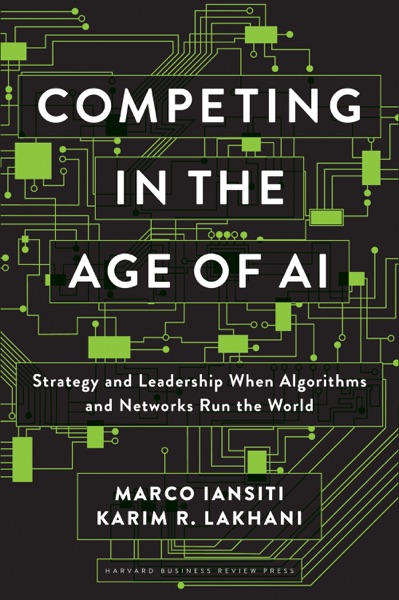
Talk to Competing in the Age of AI like its author wrote you back.
Get the ideas that fit your life — not generic summaries.
- Chat with the book
- Audiobook-style main ideas
- Adapts to your life and goals
- Helps you take action
What it argues
Competing in the Age of AI is Marco Iansiti and Karim Lakhani's argument that artificial intelligence is not just another technology to be adopted, but a fundamental redesign of how firms operate — and that companies built from the start with AI at their core will eventually displace firms that try to bolt AI onto traditional operating models. Both authors are Harvard Business School professors who have spent years studying how technology reshapes industries, and the book draws on extensive case studies from companies including Amazon, Ant Financial, Alibaba, and Google.
The central concept is the "AI factory": a system that continuously collects data, processes it through algorithms, and deploys software at scale, replacing the judgment-intensive, human-bottlenecked decision trees that traditional businesses depend on. An AI-native firm like Amazon isn't just selling things online; it's running millions of small algorithmic decisions simultaneously — pricing, inventory, recommendation, logistics — with minimal human involvement in individual transactions. That operating model is fundamentally different from a traditional retailer, not just more efficient.
What it gets right
- 1.
AI-native firms have a fundamentally different operating model: they replace human decision-making in individual transactions with continuous algorithmic processes, enabling scale without proportional headcount growth.
- 2.
The AI factory — collecting data, training algorithms, deploying software — creates a learning loop in which each interaction improves performance, generating self-reinforcing competitive advantage.
- 3.
Network effects in AI businesses operate through data accumulation: more usage generates more data, which improves the algorithm, which attracts more usage. This is structurally different from traditional network effects.
What it covers
Who wrote it
Marco Iansiti is the David Sarnoff Professor of Business Administration at Harvard Business School and Faculty Chair of the Digital Initiative. He has studied the impact of technology on business strategy and operations for more than two decades. Karim Lakhani is the Charles Edward Wilson Professor of Business Administration at Harvard Business School and co-founder of the Laboratory for Innovation Science. Together they have advised major corporations and government agencies on AI strategy and digital transformation. Competing in the Age of AI draws on research involving dozens of companies across multiple industries and geographies.
