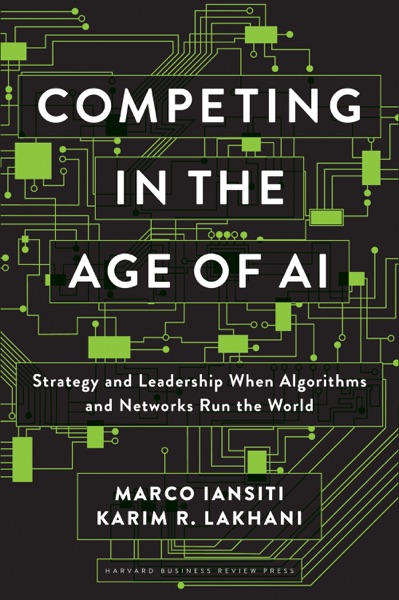
Competing in the Age of AI by Marco Iansiti & Karim Lakhani is a 2020 business book about artificial intelligence, business strategy, digital transformation. AI-native firms have a fundamentally different operating model: they replace human decision-making in individual transactions with continuous algorithmic processes, enabling scale without proportional headcount growth.
Summary
Competing in the Age of AI is Marco Iansiti and Karim Lakhani's argument that artificial intelligence is not just another technology to be adopted, but a fundamental redesign of how firms operate — and that companies built from the start with AI at their core will eventually displace firms that try to bolt AI onto traditional operating models. Both authors are Harvard Business School professors who have spent years studying how technology reshapes industries, and the book draws on extensive case studies from companies including Amazon, Ant Financial, Alibaba, and Google.
The central concept is the "AI factory": a system that continuously collects data, processes it through algorithms, and deploys software at scale, replacing the judgment-intensive, human-bottlenecked decision trees that traditional businesses depend on. An AI-native firm like Amazon isn't just selling things online; it's running millions of small algorithmic decisions simultaneously — pricing, inventory, recommendation, logistics — with minimal human involvement in individual transactions. That operating model is fundamentally different from a traditional retailer, not just more efficient.
The authors argue that AI creates a new kind of competitive advantage: network effects operating through data. Each transaction generates data that improves the algorithm, which improves the service, which attracts more transactions. Unlike traditional businesses, where scale increases coordination costs, AI-native firms can scale without proportionally increasing human headcount. This makes the cost curves and competitive dynamics of AI-native firms structurally different from traditional ones.
The book's second half addresses strategy and leadership for incumbents trying to transform themselves. Iansiti and Lakhani are honest that this is hard: legacy systems, organizational structures, and cultures designed for human-intensive processes are resistant to redesign. They offer a framework for how incumbents can build AI capabilities incrementally, but the book is more confident about what AI-native firms can do than about how traditional firms can catch up. The gap between diagnosis and prescription is the book's main limitation.
Talk to Competing in the Age of AI like its author wrote you back.
Get the ideas that fit your life — not generic summaries.
- Chat with the book
- Audiobook-style main ideas
- Adapts to your life and goals
- Helps you take action
Key takeaways
- 1.
AI-native firms have a fundamentally different operating model: they replace human decision-making in individual transactions with continuous algorithmic processes, enabling scale without proportional headcount growth.
- 2.
The AI factory — collecting data, training algorithms, deploying software — creates a learning loop in which each interaction improves performance, generating self-reinforcing competitive advantage.
- 3.
Network effects in AI businesses operate through data accumulation: more usage generates more data, which improves the algorithm, which attracts more usage. This is structurally different from traditional network effects.
- 4.
Traditional organizational structures — hierarchies, silos, management layers designed to coordinate human work — are poorly suited to AI-native operating models, which require different governance and incentive structures.
- 5.
The talent bottleneck for AI transformation is not primarily technical: it's leadership that can envision new operating models and build the organizational structures to support them.
- 6.
Incumbents face a genuine transformation challenge because legacy systems and cultures were designed for processes that AI replaces. Incremental improvement of existing models may not be sufficient.
- 7.
Universal cognitive tasks — pattern recognition, prediction, decision optimization — are increasingly performed by algorithms. The human skills that retain value are those that require original judgment, creativity, and relationship management.
- 8.
Ethical questions about AI — bias, accountability, transparency — are not external to strategy but central to it. Firms that don't build governance for AI decision-making will face regulatory and reputational risks that undermine competitive position.
Discussion questions
Use these on your own, with a book club, or as chat starters in Superbook. Book club version, ready to copy or print →
- 1.
Iansiti and Lakhani argue that AI is not just another technology but a fundamental redesign of how firms operate. Does the distinction hold up, or is every major technology shift described in similarly sweeping terms?
- 2.
Which traditional businesses in your industry or experience are most exposed to displacement by AI-native competitors, and why?
- 3.
The AI factory model assumes you have the data and the algorithms to replace human decisions. What kinds of business decisions are hardest to algorithmize, and why?
- 4.
The book argues that traditional organizational structures are poorly suited to AI-native operating models. What specifically would need to change in an organization you know well?
- 5.
Data network effects favor incumbents with large existing user bases. What does that imply for new entrants trying to compete in markets where established players have data advantages?
- 6.
The authors acknowledge that incumbents face a genuine transformation challenge. Is incremental adoption of AI sufficient, or does transformation require rebuilding from scratch?
- 7.
The book was published in 2020 and describes AI capabilities as of that period. What has changed since, and how does it affect the book's argument?
- 8.
What human skills become more valuable in a world where AI handles routine cognitive tasks? What becomes less valuable?
- 9.
Iansiti and Lakhani treat ethics as central to AI strategy. Do you think most firms actually integrate those considerations strategically, or treat them primarily as compliance?
- 10.
The case studies in the book are heavily weighted toward US and Chinese technology giants. How well do the frameworks apply to smaller firms, different geographies, or different industries?
- 11.
If you were building a new business from scratch today, what would 'AI-native from the start' look like in a domain you know well?
Themes
Frequently asked questions
-
Is Competing in the Age of AI still current?
The framework — AI factories, data network effects, the transformation challenge for incumbents — holds up well. The specific technology examples have aged, and the authors couldn't have anticipated the generative AI wave of 2022–2024. The strategic logic is more durable than the specific case studies.
-
How long does it take to read?
Around five hours. The book is about 280 pages and is written in clear academic-to-practitioner prose. The frameworks are introduced methodically and illustrated with case studies. It rewards taking notes, not skimming.
-
Who is this book for?
Business leaders and strategists in any industry facing AI disruption, MBA students and academics studying digital strategy, and anyone who wants a rigorous framework for thinking about AI as a competitive force rather than a technology trend.
-
What's the book's main weakness?
The gap between diagnosis and prescription. Iansiti and Lakhani are very clear about what AI-native firms can do and why incumbents struggle. They're less clear about how an incumbent actually executes a successful transformation. The advice is directionally right but not operationally specific.
-
How does this compare to other AI business books?
It's more analytically rigorous than most. Books like The Second Machine Age or Life 3.0 are broader; Competing in the Age of AI is specifically about competitive dynamics and operating model design. For the strategy question rather than the technology or philosophical question, it's one of the better sources.
Similar books
The Innovator's Dilemma
Clayton M. Christensen
Zero to One: Notes on Startups, or How to Build the Future
Peter Thiel
Superintelligence: Paths, Dangers, Strategies
Nick Bostrom
Power and Prediction: The Disruptive Economics of Artificial Intelligence
Ajay Agrawal, Joshua Gans, and Avi Goldfarb
