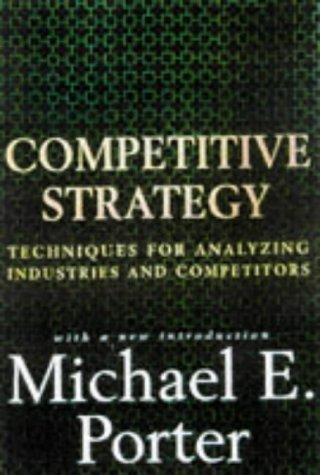
Talk to Competitive Strategy like its author wrote you back.
Get the ideas that fit your life — not generic summaries.
- Chat with the book
- Audiobook-style main ideas
- Adapts to your life and goals
- Helps you take action
Competitive Strategy, in detail
Competitive Strategy is Michael Porter's foundational framework for analyzing industries and developing competitive strategy. Published in 1980 when strategic planning was dominated by portfolio matrices and market share doctrine, it shifted the field by asking a more fundamental question: what determines whether an industry is attractive, and what determines which companies within that industry can achieve sustained profitability?
The Five Forces framework is Porter's answer to the first question. The profitability of any industry is shaped by five structural forces: the intensity of rivalry among existing competitors, the threat of new entrants, the bargaining power of buyers, the bargaining power of suppliers, and the threat of substitute products. An industry where all five forces are weak — like pharmaceuticals in the 1990s — generates consistently high returns. An industry where multiple forces are strong — like commodity airlines — generates chronically poor returns regardless of how well individual companies are managed. The implication: before investing in strategy, understand your structural position.
For the second question — which companies within an industry can outperform — Porter offers three generic strategies: cost leadership (being the lowest-cost producer in the industry), differentiation (offering something unique that buyers will pay a premium for), and focus (targeting a specific segment and competing within it on either cost or differentiation terms). The most dangerous position is being stuck in the middle — neither the cost leader nor clearly differentiated — because the company has no sustainable competitive position.
Competitive Strategy is dense and academic in tone; Porter is a Harvard Business School professor writing primarily for strategy consultants and executives. The book is longer and more rigorous than most business books, and some sections on competitor analysis and industry evolution require sustained attention. But the Five Forces and the three generic strategies have become the most widely used frameworks in business strategy for good reason — they are precisely defined and empirically grounded in a way that many simpler strategy frameworks are not.
The big ideas
- 1.
Industry structure, not company execution, is the primary determinant of average profitability. Choosing the right industry matters as much as competing well within it.
- 2.
The Five Forces framework: rivalry intensity, threat of new entrants, bargaining power of buyers, bargaining power of suppliers, and threat of substitutes collectively determine industry attractiveness.
- 3.
Entry barriers — economies of scale, brand identity, capital requirements, switching costs, government policy — determine how easily new competitors can enter and erode industry returns.
