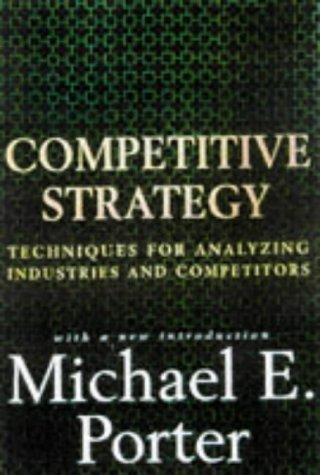
Competitive Strategy by Michael E. Porter is a 1980 business book about strategy, competition, industry analysis. Industry structure, not company execution, is the primary determinant of average profitability. Choosing the right industry matters as much as competing well within it.
Summary
Competitive Strategy is Michael Porter's foundational framework for analyzing industries and developing competitive strategy. Published in 1980 when strategic planning was dominated by portfolio matrices and market share doctrine, it shifted the field by asking a more fundamental question: what determines whether an industry is attractive, and what determines which companies within that industry can achieve sustained profitability?
The Five Forces framework is Porter's answer to the first question. The profitability of any industry is shaped by five structural forces: the intensity of rivalry among existing competitors, the threat of new entrants, the bargaining power of buyers, the bargaining power of suppliers, and the threat of substitute products. An industry where all five forces are weak — like pharmaceuticals in the 1990s — generates consistently high returns. An industry where multiple forces are strong — like commodity airlines — generates chronically poor returns regardless of how well individual companies are managed. The implication: before investing in strategy, understand your structural position.
For the second question — which companies within an industry can outperform — Porter offers three generic strategies: cost leadership (being the lowest-cost producer in the industry), differentiation (offering something unique that buyers will pay a premium for), and focus (targeting a specific segment and competing within it on either cost or differentiation terms). The most dangerous position is being stuck in the middle — neither the cost leader nor clearly differentiated — because the company has no sustainable competitive position.
Competitive Strategy is dense and academic in tone; Porter is a Harvard Business School professor writing primarily for strategy consultants and executives. The book is longer and more rigorous than most business books, and some sections on competitor analysis and industry evolution require sustained attention. But the Five Forces and the three generic strategies have become the most widely used frameworks in business strategy for good reason — they are precisely defined and empirically grounded in a way that many simpler strategy frameworks are not.
Talk to Competitive Strategy like its author wrote you back.
Get the ideas that fit your life — not generic summaries.
- Chat with the book
- Audiobook-style main ideas
- Adapts to your life and goals
- Helps you take action
Key takeaways
- 1.
Industry structure, not company execution, is the primary determinant of average profitability. Choosing the right industry matters as much as competing well within it.
- 2.
The Five Forces framework: rivalry intensity, threat of new entrants, bargaining power of buyers, bargaining power of suppliers, and threat of substitutes collectively determine industry attractiveness.
- 3.
Entry barriers — economies of scale, brand identity, capital requirements, switching costs, government policy — determine how easily new competitors can enter and erode industry returns.
- 4.
Three generic strategies provide sustainable competitive positions: cost leadership, differentiation, and focus. Being stuck in the middle — neither cheap nor clearly differentiated — is the least defensible position.
- 5.
Cost leadership requires relentless attention to every element of the cost structure, not just manufacturing. It is one generic strategy, not a fallback when differentiation fails.
- 6.
Differentiation must be grounded in actual buyer value — something buyers care about enough to pay a premium for — not just features the company values internally.
- 7.
Competitor analysis should include not only what competitors are doing now but their future goals, assumptions about the industry, capabilities, and response patterns.
- 8.
Industry evolution changes the five forces over time. Strategies that work in an emerging industry often become liabilities when the industry matures or faces structural change.
Discussion questions
Use these on your own, with a book club, or as chat starters in Superbook. Book club version, ready to copy or print →
- 1.
Apply the Five Forces to an industry you know well. Which force is most powerful? How does that shape the strategic choices available to companies in that industry?
- 2.
Porter says the most dangerous competitive position is being stuck in the middle. Where do you see companies that are neither cost leaders nor differentiated, and what is their trajectory?
- 3.
Can a company be both a cost leader and differentiated simultaneously? Porter says no — that pursuing both usually leads to being stuck in the middle. Do you agree?
- 4.
How do entry barriers shape the competitive dynamics of an industry you follow? What would lower those barriers, and what would that mean for existing players?
- 5.
Porter wrote this in 1980, before the internet, platform businesses, and network effects were dominant. What would he add to the Five Forces framework today?
- 6.
The threat of substitutes is different from the threat of new entrants. What is an example of a substitution threat that destroyed an industry that wasn't adequately competed away by a new entrant?
- 7.
Porter's three generic strategies assume a single competitive position. Is that assumption still valid in markets where companies can rapidly shift between positions?
- 8.
Buyer power and supplier power are structural factors, not just negotiating tactics. How does a company shift its position on one of these forces over time?
- 9.
Industry structure determines average profitability, but individual companies outperform their industry average. What allows specific companies to beat the structural average consistently?
- 10.
How does the generic strategies framework apply to nonprofit organizations, government agencies, or other non-commercial entities?
- 11.
Porter's framework is primarily a diagnostic tool — it tells you what's happening but requires judgment to prescribe what to do. What are its limitations as an action-planning framework?
- 12.
Choose a company that has recently changed its competitive strategy. Map the before and after on the Five Forces framework. What changed in the structure, and what did the company do in response?
Themes
Frequently asked questions
-
Is Competitive Strategy still relevant today?
The Five Forces framework remains one of the most useful tools in strategy. The generic strategies have aged well. Some of the industry-specific analysis is dated. Platform businesses and network effects require additions to the framework that Porter has partly addressed in later work, but the foundations are sound.
-
How difficult is Competitive Strategy to read?
It is dense. Porter writes for a business school audience, and the book is structured more like a textbook than a trade business book. Many readers get the core framework from the first few chapters and use the rest as a reference. Joan Magretta's Understanding Michael Porter provides an accessible synthesis.
-
What is Porter's Five Forces in brief?
Five structural forces that determine industry profitability: the intensity of rivalry among existing competitors, the threat of new entrants, the bargaining power of buyers, the bargaining power of suppliers, and the threat of substitute products. The combined strength of these forces determines whether an industry generates high or low average returns.
-
What are Porter's three generic strategies?
Cost leadership (being the lowest-cost producer in the industry), differentiation (offering something unique buyers will pay a premium for), and focus (targeting a narrow segment and competing on cost or differentiation within it). Being stuck between strategies is the least defensible position.
-
How does Blue Ocean Strategy relate to Porter's framework?
Blue Ocean Strategy is partly a critique of Porter — it argues that competing within existing industry structures (red oceans) is less profitable than creating new market space. Porter would respond that his framework applies to new market spaces too: once you create a new market, the five forces begin to shape it. The frameworks are complementary when used together.
Similar books
Blue Ocean Strategy
W. Chan Kim and Renée Mauborgne
Good Strategy Bad Strategy
Richard Rumelt
Playing to Win: How Strategy Really Works
Roger L. Martin and A.G. Lafley
The Innovator's Solution
Clayton M. Christensen and Michael E. Raynor
