Talk to Complexity like its author wrote you back.
Get the ideas that fit your life — not generic summaries.
- Chat with the book
- Audiobook-style main ideas
- Adapts to your life and goals
- Helps you take action
Complexity, in detail
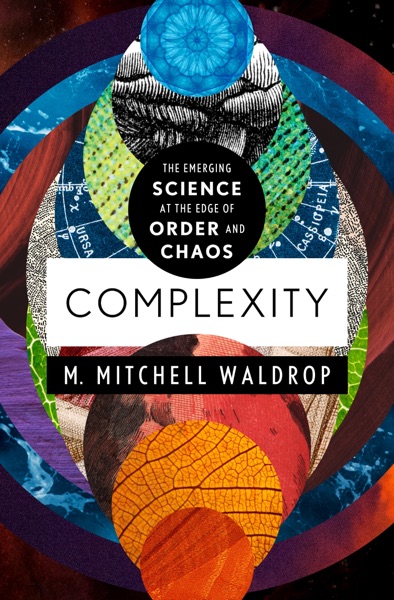
Complexity is M. Mitchell Waldrop's account of the founding of the Santa Fe Institute and the emergence of complexity science as a new intellectual framework for understanding systems that don't behave the way classical science predicts. The book is structured as narrative nonfiction, following the economists, biologists, physicists, and computer scientists who gathered in Santa Fe in the 1980s to ask whether there might be universal principles governing how order emerges from chaos — principles that cut across disciplines from economics to ecology to evolutionary biology.
The central characters include economist Brian Arthur, whose work on increasing returns and path dependence challenged the equilibrium assumptions that underpinned mainstream economics; physicist Murray Gell-Mann, Nobel laureate and co-founder of the institute; and biologist Stuart Kauffman, whose computational models suggested that life's capacity for self-organization might be a property of complex chemistry rather than a lucky accident. Waldrop follows each of their intellectual journeys in detail, tracing how ideas developed across careers and conversations.
The science itself centers on a handful of connected ideas: that complex systems — economies, ecosystems, immune systems, neural networks — tend to sit at the "edge of chaos," a zone between total order and total randomness where interesting behavior emerges. In that zone, systems are adaptive, capable of learning, and capable of evolving without being directed. The conventional scientific toolkit of reductionism and equilibrium analysis misses this behavior almost entirely, which explains why so many real-world systems seem to behave irrationally or unpredictably by conventional measures.
Waldrop writes accessibly for a general audience and the narrative approach keeps what might otherwise be dry mathematics readable. The book is now more than thirty years old, and some of the specific claims made about complexity's explanatory power have been tempered by subsequent research. But as a portrait of how a new scientific paradigm forms — through unlikely collaborations, institutional resistance, and the gradual crystallization of shared vocabulary — it remains one of the better books on the sociology of science.
The big ideas
- 1.
Complex adaptive systems — from immune systems to markets — share structural properties that classical reductionism doesn't capture. Emergence is a real phenomenon, not a metaphor.
- 2.
The 'edge of chaos' is a region between complete order and complete randomness where complex behavior, adaptation, and learning tend to occur.
- 3.
Brian Arthur's work on increasing returns showed that economies don't always converge on the most efficient equilibrium. History matters: early small advantages can lock in outcomes.
