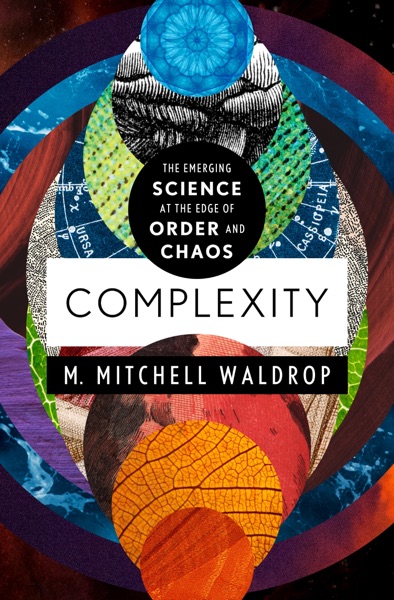
Complexity by M. Mitchell Waldrop is a 1992 science book about complex systems, emergence, interdisciplinary science. Complex adaptive systems — from immune systems to markets — share structural properties that classical reductionism doesn't capture. Emergence is a real phenomenon, not a metaphor.
Summary
Complexity is M. Mitchell Waldrop's account of the founding of the Santa Fe Institute and the emergence of complexity science as a new intellectual framework for understanding systems that don't behave the way classical science predicts. The book is structured as narrative nonfiction, following the economists, biologists, physicists, and computer scientists who gathered in Santa Fe in the 1980s to ask whether there might be universal principles governing how order emerges from chaos — principles that cut across disciplines from economics to ecology to evolutionary biology.
The central characters include economist Brian Arthur, whose work on increasing returns and path dependence challenged the equilibrium assumptions that underpinned mainstream economics; physicist Murray Gell-Mann, Nobel laureate and co-founder of the institute; and biologist Stuart Kauffman, whose computational models suggested that life's capacity for self-organization might be a property of complex chemistry rather than a lucky accident. Waldrop follows each of their intellectual journeys in detail, tracing how ideas developed across careers and conversations.
The science itself centers on a handful of connected ideas: that complex systems — economies, ecosystems, immune systems, neural networks — tend to sit at the "edge of chaos," a zone between total order and total randomness where interesting behavior emerges. In that zone, systems are adaptive, capable of learning, and capable of evolving without being directed. The conventional scientific toolkit of reductionism and equilibrium analysis misses this behavior almost entirely, which explains why so many real-world systems seem to behave irrationally or unpredictably by conventional measures.
Waldrop writes accessibly for a general audience and the narrative approach keeps what might otherwise be dry mathematics readable. The book is now more than thirty years old, and some of the specific claims made about complexity's explanatory power have been tempered by subsequent research. But as a portrait of how a new scientific paradigm forms — through unlikely collaborations, institutional resistance, and the gradual crystallization of shared vocabulary — it remains one of the better books on the sociology of science.
Talk to Complexity like its author wrote you back.
Get the ideas that fit your life — not generic summaries.
- Chat with the book
- Audiobook-style main ideas
- Adapts to your life and goals
- Helps you take action
Key takeaways
- 1.
Complex adaptive systems — from immune systems to markets — share structural properties that classical reductionism doesn't capture. Emergence is a real phenomenon, not a metaphor.
- 2.
The 'edge of chaos' is a region between complete order and complete randomness where complex behavior, adaptation, and learning tend to occur.
- 3.
Brian Arthur's work on increasing returns showed that economies don't always converge on the most efficient equilibrium. History matters: early small advantages can lock in outcomes.
- 4.
Stuart Kauffman's NK models suggested that self-organization is a property of sufficiently interconnected systems, implying that life's emergence from chemistry may not have required extraordinary luck.
- 5.
The Santa Fe Institute deliberately brought together economists, physicists, biologists, and computer scientists because the most interesting questions were falling between disciplinary borders.
- 6.
Computer simulation opened new territory for science: questions too complex for analytical solutions became tractable when you could build agent-based models and watch what emerged.
- 7.
Conventional economics assumed equilibrium and rational actors. Complexity science showed that real economies are perpetually out of equilibrium and filled with agents acting on incomplete, locally bounded information.
- 8.
Interdisciplinary science is organizationally hard. The story of the Santa Fe Institute is partly about building institutional structures that let researchers talk across the barriers that universities enforce.
Discussion questions
Use these on your own, with a book club, or as chat starters in Superbook. Book club version, ready to copy or print →
- 1.
Waldrop describes scientists who felt their home disciplines had stopped asking the interesting questions. Have you encountered that feeling in your own work or study?
- 2.
Brian Arthur's theory of increasing returns was resisted by mainstream economics for years. What does that resistance say about how paradigms protect themselves?
- 3.
The edge of chaos concept suggests that living systems tune themselves toward maximum adaptability. Can you identify a human organization — a company, a family, an institution — that seems to sit at that edge?
- 4.
Emergence means the whole is not predictable from the parts. Where in your own life have you seen emergence — outcomes that no individual component could have produced alone?
- 5.
Waldrop suggests that many fields use the wrong toolkit because the right one didn't exist yet. What assumption in a field you know well might be similarly load-bearing and wrong?
- 6.
The Santa Fe Institute was founded on the belief that the most important problems are interdisciplinary. What problem do you care about that is clearly bigger than one discipline?
- 7.
Path dependence means small early events can lock in long-term outcomes. Can you think of an example from history or your own life where an early contingency shaped everything that followed?
- 8.
Kauffman's work suggests life may not be as improbable as it seems. Does that argument change your intuitions about the prevalence of life elsewhere in the universe?
- 9.
Computer simulation allowed complexity scientists to study systems that couldn't be solved analytically. Has simulation changed the way questions are asked in a field you follow?
- 10.
Waldrop portrays the intellectual culture at Santa Fe as unusually open and cross-disciplinary. What would need to change in conventional academic institutions to enable that kind of culture more broadly?
- 11.
The book is from 1992. Which of the ideas it introduces now seem prescient, and which have proven less predictive than the participants hoped?
Themes
Frequently asked questions
-
Is Complexity by Waldrop worth reading in 2026?
Yes, though with the understanding that it is a historical document as much as a science book. The ideas it introduces — emergence, increasing returns, the edge of chaos — remain influential. Reading it alongside more recent work on networks or complex systems provides useful context for how the field has developed.
-
How long does it take to read Complexity?
About eight hours at average reading pace. The narrative structure makes it read faster than a textbook on the same material, though the chapters on individual researchers vary in density.
-
What is complexity science actually about?
It studies systems made of many interacting parts — economies, ecosystems, immune systems, neural networks — that produce emergent behavior not predictable from the parts alone. Its core claim is that these systems share structural properties across domains, and that those properties can be studied scientifically.
-
Who should read this book?
Scientists or policy thinkers who feel their tools don't match the messiness of real systems, general readers interested in how scientific revolutions happen, and anyone curious about economics, biology, or computer science who suspects the conventional frameworks leave something important out.
-
What's the most important idea in the book?
Probably increasing returns and path dependence, as developed by Brian Arthur. The idea that economies can be locked into suboptimal outcomes by historical accident rather than converging on efficient equilibria has deeply influenced economics, technology strategy, and policy.
Similar books
Chaos: Making a New Science
James Gleick
The Structure of Scientific Revolutions
Thomas S. Kuhn
Thinking in Systems
Donella H. Meadows
Antifragile: Things That Gain from Disorder
Nassim Nicholas Taleb
