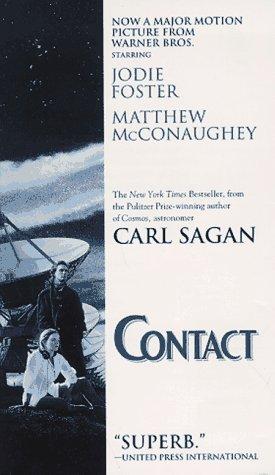
Talk to Contact like its author wrote you back.
Get the ideas that fit your life — not generic summaries.
- Chat with the book
- Audiobook-style main ideas
- Adapts to your life and goals
- Helps you take action
What it argues
Contact follows Ellie Arroway, an astronomer and SETI researcher who has spent her career scanning the skies for evidence of extraterrestrial intelligence. When a signal arrives — a clear, structured message from the direction of Vega — her personal story and humanity's largest questions collide. The signal contains plans for a machine. Building it requires international cooperation, enormous resources, and a level of trust between ideological enemies that barely exists. The novel follows both the scientific process of decoding the message and the political process of deciding what to do with it.
Carl Sagan was a scientist first and a novelist incidentally, and Contact bears both marks. The science is serious — the SETI research protocols, the mathematics of the message, the physics of the machine — and the novel's core question about the relationship between scientific evidence and personal belief is one Sagan had been arguing his entire public life. Ellie is, in many ways, a self-portrait: rational, lonely, committed to empiricism against the resistance of a culture that finds meaning elsewhere.
What it gets right
- 1.
Sagan's central argument is that the scientific method and the religious impulse both represent attempts to understand our place in something larger — and that the conflict between them is partly a territorial dispute, not a fundamental incompatibility.
- 2.
Ellie's ending places her in the exact epistemological position of the religious believer: holding an experience she cannot verify, knowing something she cannot prove to others.
- 3.
The political sections of the novel — international cooperation, ideological competition over the machine — are as carefully drawn as the scientific ones. Sagan understood that scientific discoveries don't exist outside power structures.
What it covers
Who wrote it
Carl Sagan was an American astronomer, cosmologist, and science communicator who spent most of his career at Cornell University. He is best known for the television series Cosmos (1980) and the books that accompanied it, including Pale Blue Dot and The Demon-Haunted World. Contact, published in 1985, was his only novel. He won a Pulitzer Prize for The Dragons of Eden (1978) and received numerous honorary degrees and awards for public science education. He died in 1996 at age 62. Contact was adapted into a film in 1997 starring Jodie Foster.
