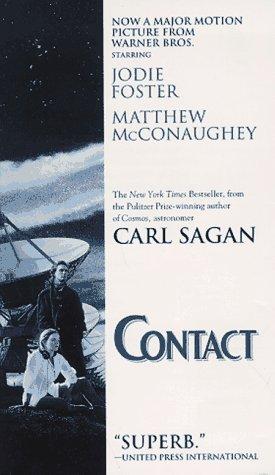
Contact by Carl Sagan is a 1985 science fiction book about science and faith, first contact, political power. Sagan's central argument is that the scientific method and the religious impulse both represent attempts to understand our place in something larger — and that the conflict between them is partly a territorial dispute, not a fundamental incompatibility.
Summary
Contact follows Ellie Arroway, an astronomer and SETI researcher who has spent her career scanning the skies for evidence of extraterrestrial intelligence. When a signal arrives — a clear, structured message from the direction of Vega — her personal story and humanity's largest questions collide. The signal contains plans for a machine. Building it requires international cooperation, enormous resources, and a level of trust between ideological enemies that barely exists. The novel follows both the scientific process of decoding the message and the political process of deciding what to do with it.
Carl Sagan was a scientist first and a novelist incidentally, and Contact bears both marks. The science is serious — the SETI research protocols, the mathematics of the message, the physics of the machine — and the novel's core question about the relationship between scientific evidence and personal belief is one Sagan had been arguing his entire public life. Ellie is, in many ways, a self-portrait: rational, lonely, committed to empiricism against the resistance of a culture that finds meaning elsewhere.
What makes the novel more than advocacy is Sagan's genuine interest in the other side. The conversations between Ellie and the religious figures she encounters are real arguments, not strawmen. The novel takes seriously the possibility that science and faith address different questions rather than competing answers to the same one. The ending — which involves an experience that cannot be independently verified — is the most honest and difficult move Sagan makes: it places his protagonist in the position of the religious believer, knowing something she cannot prove.
Contact rewards readers who want science fiction that takes ideas seriously rather than using them as backdrop. The pacing is deliberate and the characters are intellectually rather than emotionally vivid. What lingers is less any particular plot event than the argument Sagan is making: that the universe is vast, that we are not its purpose, and that this is not diminishment but invitation.
Talk to Contact like its author wrote you back.
Get the ideas that fit your life — not generic summaries.
- Chat with the book
- Audiobook-style main ideas
- Adapts to your life and goals
- Helps you take action
Key takeaways
- 1.
Sagan's central argument is that the scientific method and the religious impulse both represent attempts to understand our place in something larger — and that the conflict between them is partly a territorial dispute, not a fundamental incompatibility.
- 2.
Ellie's ending places her in the exact epistemological position of the religious believer: holding an experience she cannot verify, knowing something she cannot prove to others.
- 3.
The political sections of the novel — international cooperation, ideological competition over the machine — are as carefully drawn as the scientific ones. Sagan understood that scientific discoveries don't exist outside power structures.
- 4.
The machine functions as a kind of religious object: incomprehensible in design, requiring faith to build, promising transformation, and delivering something that exceeds expectation in ways that can't be communicated.
- 5.
Ellie's father-hunger — her longing for the dead father she barely knew — is the emotional engine underneath the cosmic one. The first contact she actually wants is personal and irrecoverable.
- 6.
Sagan populates the novel with scientific women navigating institutional resistance, which was pointed in 1985 and reads as historically accurate rather than dated.
- 7.
The Vegan message is structured as an IQ test for civilizations — mathematics first, then more complex layers. Sagan's design reflects his actual beliefs about how communication across intelligence gaps would have to work.
- 8.
The ending refuses the resolution most science fiction would provide. The experience happened; it cannot be verified; it changes everything and nothing. Sagan earns this by building the epistemology carefully throughout.
Discussion questions
Use these on your own, with a book club, or as chat starters in Superbook. Book club version, ready to copy or print →
- 1.
Ellie ends the novel in the position of the religious believer — holding an unverifiable experience. Does Sagan seem to think this is ironic, a vindication of religious epistemology, or something else entirely?
- 2.
The political maneuvering around the machine — who gets on it, what it means geopolitically — is as detailed as the science. Does that feel like Sagan's natural concern, or a digression from the main story?
- 3.
The Vegans built the machine to test whether humanity could cooperate at a planetary level. Does humanity pass? Does Sagan think we do?
- 4.
The conversations between Ellie and Rankin (the evangelical) are the novel's most interesting philosophical exchanges. Which character does the novel seem to favor — or is it genuinely agnostic?
- 5.
Sagan's Ellie is a self-portrait: rational, lonely, committed to evidence. Is she a fully realized character to you, or a philosophical position with a name?
- 6.
Contact treats interstellar communication as primarily a mathematical and linguistic problem. Is that assumption still plausible to you, or has our thinking about intelligence changed enough to question it?
- 7.
The ending's ambiguity is famous. Do you read it as Ellie having genuinely made contact with something, as a simulation or illusion she experienced, or as deliberately unresolvable?
- 8.
Compared to Blindsight's hostile and incomprehensible aliens, Contact's Vegans are relatively benevolent and communicative. What does each novel's alien design say about its author's assumptions about intelligence?
- 9.
Science funding, institutional politics, and government interference are constant features of Ellie's career. How much does the novel's depiction of scientific work feel like Sagan's experience rather than fiction?
- 10.
The signal contains what turns out to be Hitler's face — the first television broadcast powerful enough to reflect back. How does Sagan use that detail, and what does it say about what we broadcast into the universe?
- 11.
Ellie's relationship with her dead father shapes her quest. Is the novel ultimately about the cosmos, or is the cosmos a way of talking about something more intimate?
- 12.
If a real SETI signal arrived tomorrow, do you think humanity would handle it anything like the novel suggests? What does your answer reveal about your assumptions about human nature?
Themes
Frequently asked questions
-
Is Contact worth reading if I've already seen the movie?
Yes. The film is a faithful and largely excellent adaptation, but the novel is significantly richer in the political and philosophical content, particularly the extended dialogues about science and faith, the details of the SETI program, and the full complexity of the ending.
-
What is the ending of Contact about?
Ellie experiences something that cannot be independently verified — an encounter that changes her fundamentally but leaves no evidence. She spends the rest of the novel in the exact position of a religious believer: knowing something she cannot prove. Sagan designed this deliberately as a meditation on evidence and faith.
-
Is Contact hard to read?
The pace is deliberate and the ideas require engagement, but the prose is clear and accessible. It's not technically demanding in the way hard SF can be. The main challenge is patience — Sagan builds carefully rather than rushing.
-
Who shouldn't read Contact?
Readers who need action and pace, and readers who want genre SF's conventional alien-contact payoffs. Sagan is interested in ideas, politics, and epistemology more than adventure. The novel is more essay than thriller.
-
Is the novel's science still accurate?
The SETI protocols and radio astronomy are well-grounded and largely still accurate. Some of the political context (Cold War dynamics) has dated. The core scientific and philosophical questions about communicating across intelligence gaps remain live.