Science · Book club
Cosmos book club questions
Here are 12 book club questions for Cosmos by Carl Sagan, ordered to open easily and end somewhere worth arguing about. Copy them, print them, or bring them up one at a time.
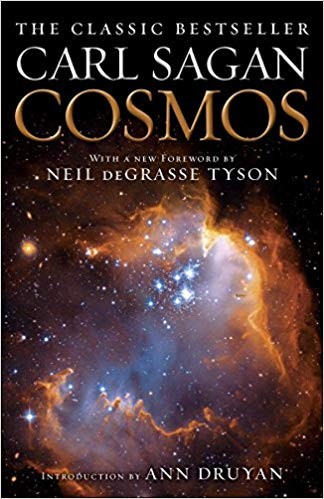
Cosmos is Carl Sagan's attempt to tell the full story of the universe and humanity's place in it — from the Big Bang to the origins of life to the rise of science as a way of knowing.
Carl Sagan · 1980 · 6h 0m
Full summary and key takeaways →The 12 questions
- 1.
Sagan argues that the suppression of Greek astronomy set humanity back by more than a thousand years. What conditions allow knowledge to be lost on that scale?
- 2.
The Cosmic Calendar makes human history look vanishingly brief. Does that sense of scale change how you think about your own priorities or the urgency of current events?
- 3.
Sagan treats science and skepticism as civic virtues, not just intellectual ones. Do you agree that a democracy depends on a scientifically literate population?
- 4.
Which chapter or idea in Cosmos did you find hardest to accept emotionally, even if you accepted it intellectually?
- 5.
Sagan's optimism about human reason coexists with evidence — including his own — of how often we fail to use it. Where do you come down on whether reason usually wins?
- 6.
He writes extensively about the threat of nuclear annihilation. The specific weapons have changed, but the structure of the problem hasn't. What replaces nuclear war as the civilizational threat in your reading?
- 7.
The book was written before the internet, before gene sequencing, before gravitational wave detection. Which discovery since 1980 would have most changed Sagan's argument?
- 8.
Sagan uses the phrase 'we are made of star-stuff' as both a scientific claim and a source of meaning. Do you find meaning in that kind of cosmic context, or does the scale feel emptying rather than enriching?
- 9.
The Drake Equation estimates the number of communicating civilizations in the galaxy. What does the Fermi paradox — we haven't heard from any of them — suggest to you?
- 10.
Cosmos blends astrophysics, history, and philosophy in a single narrative. What are the risks of that approach, and where do you think Sagan pulls it off versus overreaches?
- 11.
Sagan is explicitly anti-superstition throughout. Is there a version of his argument that is respectful of religious experience without conceding the epistemological point?
- 12.
If you were writing the chapter Sagan would add in 2026, what would it cover?
How to run the discussion
- Pick six to eight, not all of them. An hour of real discussion covers fewer questions than anyone expects, and racing the list is what makes a book club feel like homework.
- Open with what people noticed, not what they concluded. Asking for a verdict first hardens opinions before anyone has heard each other.
- Let the disagreement run. The questions below that split a room are the ones worth the time; the ones everyone answers the same way can be skipped.
- Ask the quiet person a specific question. A direct, narrow question is far easier to answer than an open invitation to contribute.
Themes worth steering toward
If the conversation stalls, these are the threads that usually restart it.
Common questions
What are good book club questions for Cosmos?
Here are 12 book club questions for Cosmos by Carl Sagan, ordered to open easily and end somewhere worth arguing about. The strongest openers ask what each reader noticed rather than what they concluded, and the discussion usually turns on universe, evolution, scientific thinking.
How long should a book club discussion of Cosmos last?
Most groups run 60 to 90 minutes of actual discussion. That is roughly six to eight questions, not all of them, so pick the ones that suit your group rather than working down the list in order.
What are the main themes in Cosmos?
Universe, Evolution, Scientific thinking, Civilization, Astronomy. Those are the threads most likely to divide a room, which makes them the useful places to steer a discussion that has gone quiet.
Picking the next one? See books like Cosmos or questions for other book club picks.
