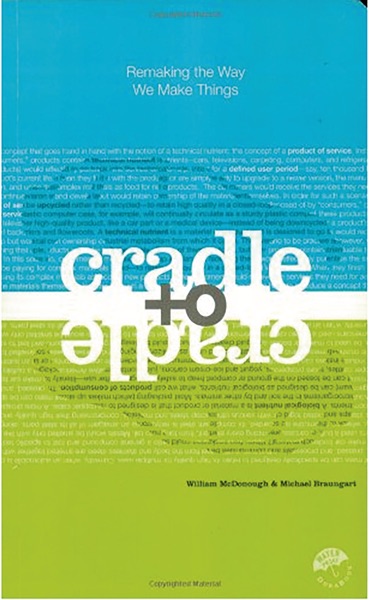
Talk to Cradle to Cradle: Remaking the Way We Make Things like its author wrote you back.
Get the ideas that fit your life — not generic summaries.
- Chat with the book
- Audiobook-style main ideas
- Adapts to your life and goals
- Helps you take action
What it argues
Cradle to Cradle is William McDonough and Michael Braungart's argument that the conventional approach to environmentalism — reducing, reusing, recycling, being "less bad" — is insufficient and in some ways misleading. The book, published in 2002 and itself printed on synthetic polymer pages rather than wood-pulp paper, proposes a different model: designing products and industrial systems so that all their materials can cycle continuously through either biological or technical streams, creating no waste and generating no toxicity.
The authors draw a contrast between two metabolisms. The biological metabolism is the natural world's nutrient cycle — organic materials that break down and return to the soil. The technical metabolism is the industrial world's ideal: materials like metals and synthetic polymers that circulate in closed industrial loops, recovered and remanufactured at the end of a product's use without being downcycled into lower-quality forms. Conventional recycling, the authors argue, is mostly downcycling: paper mixed with inks and contaminants that can only become lower grades of paper; metals alloyed with incompatible traces that reduce their value. True circularity requires that materials be designed for disassembly and recovery from the start.
What it gets right
- 1.
Being 'less bad' is not good enough. Reducing harm incrementally still produces harm. The goal should be designing for no negative impact — products that are safe, circular, and regenerative.
- 2.
All materials exist in either a biological metabolism (organic, returning to soil) or a technical metabolism (synthetic, returning to industry). Both can be cycled endlessly if designed correctly.
- 3.
Conventional recycling is mostly downcycling: mixed materials lose quality and value at every pass. True circularity requires designing products for disassembly and material recovery from the start.
What it covers
Who wrote it
William McDonough is an American architect and designer, founder of William McDonough + Partners and the co-founder of MBDC, a product and process design firm. Michael Braungart is a German chemist and professor, co-founder of EPEA (Environmental Protection Encouragement Agency) and McDonough Braungart Design Chemistry. Together they developed the Cradle to Cradle certification framework and protocol, which is used by manufacturers in over sixty countries to assess and improve the material health and circularity of their products. Cradle to Cradle, published in 2002, is their most widely read collaboration.
