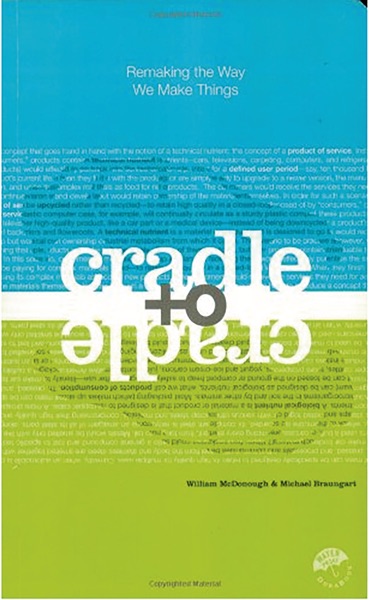
Cradle to Cradle: Remaking the Way We Make Things by William McDonough & Michael Braungart is a 2002 science book about sustainability, design, circular economy. Being 'less bad' is not good enough. Reducing harm incrementally still produces harm. The goal should be designing for no negative impact — products that are safe, circular, and regenerative.
Summary
Cradle to Cradle is William McDonough and Michael Braungart's argument that the conventional approach to environmentalism — reducing, reusing, recycling, being "less bad" — is insufficient and in some ways misleading. The book, published in 2002 and itself printed on synthetic polymer pages rather than wood-pulp paper, proposes a different model: designing products and industrial systems so that all their materials can cycle continuously through either biological or technical streams, creating no waste and generating no toxicity.
The authors draw a contrast between two metabolisms. The biological metabolism is the natural world's nutrient cycle — organic materials that break down and return to the soil. The technical metabolism is the industrial world's ideal: materials like metals and synthetic polymers that circulate in closed industrial loops, recovered and remanufactured at the end of a product's use without being downcycled into lower-quality forms. Conventional recycling, the authors argue, is mostly downcycling: paper mixed with inks and contaminants that can only become lower grades of paper; metals alloyed with incompatible traces that reduce their value. True circularity requires that materials be designed for disassembly and recovery from the start.
The practical examples are varied: a factory that releases water cleaner than the stream it draws from; a fabric made entirely of materials safe enough to compost; an office building designed to generate more energy than it uses. McDonough and Braungart are architects and industrial chemists respectively, and the combination gives the book both practical grounding and cross-disciplinary range. They argue that ecologically intelligent design is not a constraint on commerce but an opportunity — products that can be safely recovered are products whose materials retain long-term value.
The book has weaknesses. Some of its claims about specific technologies were aspirational when written and remain so more than two decades later. And the framework, while intellectually useful, glosses over the governance and economic structures that make true cradle-to-cradle systems difficult to implement at scale. But as a critique of the "eco-efficiency" paradigm and a provocation toward genuinely regenerative design, it remains one of the most influential books in sustainable design thinking.
Talk to Cradle to Cradle: Remaking the Way We Make Things like its author wrote you back.
Get the ideas that fit your life — not generic summaries.
- Chat with the book
- Audiobook-style main ideas
- Adapts to your life and goals
- Helps you take action
Key takeaways
- 1.
Being 'less bad' is not good enough. Reducing harm incrementally still produces harm. The goal should be designing for no negative impact — products that are safe, circular, and regenerative.
- 2.
All materials exist in either a biological metabolism (organic, returning to soil) or a technical metabolism (synthetic, returning to industry). Both can be cycled endlessly if designed correctly.
- 3.
Conventional recycling is mostly downcycling: mixed materials lose quality and value at every pass. True circularity requires designing products for disassembly and material recovery from the start.
- 4.
Waste equals food in a well-designed system. The by-products of one process become the feedstocks of another. This requires deliberate, systems-level design rather than end-of-life remediation.
- 5.
Ecologically intelligent design is a commercial opportunity, not just a cost. Materials that can be safely recovered retain value; products designed for disassembly can be leased rather than sold.
- 6.
Many common products — computers, carpets, packaging — are made from mixtures of materials designed only for initial manufacture, with no attention to what happens at end of life.
- 7.
The industrial revolution's habits of resource extraction, use, and disposal reflect a particular historical moment. They are not economic laws, and they can be changed through better design and different incentive structures.
Discussion questions
Use these on your own, with a book club, or as chat starters in Superbook. Book club version, ready to copy or print →
- 1.
McDonough and Braungart argue that incremental eco-efficiency is the wrong target. Do you find their critique of 'being less bad' convincing, or is it too idealistic for current industrial reality?
- 2.
Can you identify a product you use daily that is genuinely designed for material recovery at end of life? What would need to change to make it so?
- 3.
The book distinguishes biological from technical metabolisms. Is this a useful conceptual distinction in practice, or does it oversimplify the complexity of real product materials?
- 4.
The authors are an architect and a chemist. Does that combination come through in the argument, and how does interdisciplinarity affect the strength of the case they make?
- 5.
Cradle to Cradle was published in 2002. How much has industrial practice moved toward the model they describe in the two decades since, and what has slowed or accelerated progress?
- 6.
The book itself is printed on synthetic polymer pages, not paper. Is this more of a provocation than a practical choice, and what does it say about the authors' priorities?
- 7.
Many sustainability initiatives in large companies emphasize carbon reduction. How does the cradle-to-cradle framework relate to — or compete with — that framing?
- 8.
McDonough and Braungart are optimistic about industrial transformation through better design. What role do regulation, taxation, and consumer behavior need to play for their vision to be achievable?
- 9.
The circular economy concept has become mainstream in policy and business since 2002. How much of that shift traces back to Cradle to Cradle, and how much has the mainstream adoption changed or diluted the original argument?
- 10.
The book is relatively short and polemical. Does it succeed as a call to action, or does it need the level of detail it lacks to be operationally useful?
- 11.
What is the most practically feasible change a designer, engineer, or product manager could make today that reflects the cradle-to-cradle principles?
Themes
Frequently asked questions
-
What is Cradle to Cradle's central argument?
That the goal of sustainable design should not be to do less harm, but to do no harm — by designing products and industrial systems so that all materials cycle continuously through biological or technical loops, generating no waste and no toxicity.
-
Is Cradle to Cradle still relevant in 2026?
Yes. The circular economy has become a major policy and business framework in the EU and elsewhere, and the conceptual distinction between biological and technical metabolisms remains a useful design heuristic. Some of the specific technology claims from 2002 have aged less well, but the core argument is more mainstream now than when it was written.
-
How long does Cradle to Cradle take to read?
About three to four hours. The book is short — under 200 pages — and written accessibly, though some passages on chemistry and industrial process are denser than others.
-
What's the difference between Cradle to Cradle and circular economy thinking?
Cradle to Cradle is one of the founding intellectual influences on the circular economy movement. The two share the emphasis on closed material loops and waste elimination, but circular economy frameworks are broader and more policy-oriented; Cradle to Cradle is more focused on design decisions at the product and material level.
-
Who should read Cradle to Cradle?
Designers, engineers, product managers, policy makers, and anyone interested in sustainable systems. It is more useful as a conceptual provocation than an implementation manual, but the provocation is genuinely valuable for anyone working on physical products or manufacturing processes.