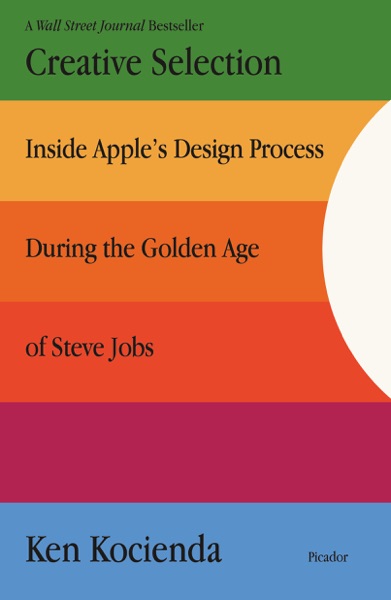
Talk to Creative Selection like its author wrote you back.
Get the ideas that fit your life — not generic summaries.
- Chat with the book
- Audiobook-style main ideas
- Adapts to your life and goals
- Helps you take action
Creative Selection, in detail
Creative Selection is Ken Kocienda's first-hand account of how software gets made at Apple during the period when the iPhone and iPad were born. Kocienda spent fifteen years at Apple, building the original iPhone keyboard and contributing to the Safari browser. The book is partly memoir, partly design philosophy, partly an argument that the way you work matters as much as what you're working on.
The central idea is what Kocienda calls "creative selection" — an iterative loop of demo, critique, and refinement that he witnessed repeatedly in Steve Jobs's review sessions. The process wasn't about committees or feature specs. An engineer or designer would build something, show it, get immediate and direct feedback, refine it, and show it again. Over hundreds of cycles, weak ideas died and strong ones survived. The keyboard auto-correction that shipped on the first iPhone was the product of exactly this kind of evolution, not a single moment of inspiration.
Kocienda is unusually honest about what building the keyboard actually looked like: months of dead ends, failed approaches, uncertainty about whether a touchscreen keyboard could even work. The book makes clear that the legendary Apple polish wasn't the result of genius alone but of enormous sustained effort and a willingness to throw out work that wasn't good enough. Jobs's demos were not just theatrical — they were the mechanism by which quality was enforced.
The book has clear limits. It covers one engineer's view of one slice of Apple during a specific era. It doesn't address the company's management structures, its hardware process, or what happened after Jobs. But as a ground-level account of how excellent software is built — the role of taste, the importance of focus, the necessity of the demo — it's more useful than most books on creativity or product development.
The big ideas
- 1.
Creative selection is the iterative process of demo, critique, and refinement. Ideas improve through repeated exposure to honest feedback, not through up-front planning.
- 2.
The demo is a forcing function. Showing real, working software — not slides or wireframes — forces concrete decisions and surfaces problems that documents hide.
- 3.
Taste in design isn't mystical. It's developed through sustained exposure to good and bad work, and through making many small judgments repeatedly.
