Talk to Crossing the Chasm like its author wrote you back.
Get the ideas that fit your life — not generic summaries.
- Chat with the book
- Audiobook-style main ideas
- Adapts to your life and goals
- Helps you take action
Crossing the Chasm, in detail
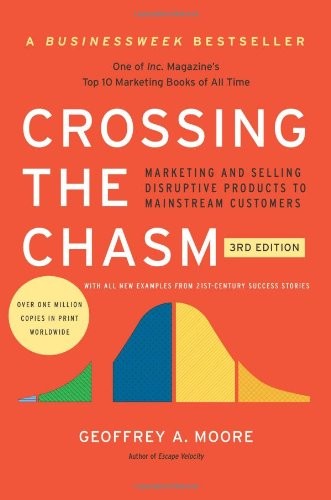
Crossing the Chasm is Geoffrey Moore's analysis of why so many technology companies succeed with early adopters and then stall before reaching mainstream customers. The technology adoption lifecycle — Innovators, Early Adopters, Early Majority, Late Majority, Laggards — was already a familiar framework when Moore published the first edition in 1991, but he identified something the original model missed: there is a dangerous discontinuity, a "chasm," between Early Adopters and the Early Majority, and falling into it has killed more promising technology companies than bad products or weak execution.
Early Adopters are visionaries. They buy new technology for competitive advantage, tolerate bugs and incompleteness, and don't need the product to fit neatly into an existing category. The Early Majority — the mainstream buyers who represent the bulk of the market — are pragmatists. They want proven solutions, references from similar buyers, complete ecosystems, and reduced risk. The visionary and the pragmatist are so different in their buying psychology that a company's success with one group can actually make the other group more cautious.
Moore's prescription for crossing the chasm is counterintuitive: rather than trying to reach the mainstream market broadly, focus all resources on dominating a single niche. He calls this the bowling pin strategy — pick the head pin, own it completely, then use that beachhead to knock over adjacent markets. The head pin should be a specific target customer with a specific pain that your product solves completely better than any alternative, with enough urgency that they will take a risk on an unproven vendor.
The book holds up well despite its age, especially its core taxonomy of buyer types and its argument that market segments should be defined by which customers can reference each other, not by industry classifications. Some of the specific examples are dated, but the underlying dynamics — the chasm between early adopters and pragmatists, the need for a beachhead strategy — are as relevant to B2B SaaS companies today as they were to workstation vendors in 1991.
The big ideas
- 1.
There is a dangerous gap — the chasm — between Early Adopters (visionaries) and the Early Majority (pragmatists) that stops most technology companies before they reach mainstream markets.
- 2.
Visionaries and pragmatists buy so differently that success with one group can make the other group more wary, not more confident.
- 3.
To cross the chasm, concentrate all resources on a single beachhead: one specific market segment with a specific problem you can solve completely.
